

Be warned, this one is a blockbuster: just one main blog item, considerably longer than usual and it will help a lot if you put your thinking cap on and take it at a gentle pace. Actually, the ideas involved are fundamentally quite simple but you will need to pay attention if most of this stuff is new to you. What’s it about? It’s a reflection on the work of Robert Trivers, a pioneer of evolutionary psychology who died recently. It’s a discipline often dismissed by Foucault fans (of whom I am one) on what I believe are misconceived grounds. What follows is my attempt to describe Trivers’ main theoretical insights and share my enthusiasm for them.
The significance for MAPs is not my main focus but it certainly exists because the work is fundamental to sexuality in general. It would be great to have some feedback on your thoughts about this. In general, Heretic TOC is fortunate to routinely attract comments running into three figures, many of which are of high quality and do a wonderful job in keeping us up to date with new research and MAP news. On this occasion, though, I would make a plea for more comments about the actual blog itself. Don’t be afraid to argue with me. I want to learn from dialogue with you all.
***
Not to put too fine a point on it, Robert Trivers, whose reflections on the origins and basis of human psychology – including sexual motivation – dug deeper than even those of Darwin or Freud, was a bit of an asshole.
Trivers, who died last month, was arrogant, boorish, unreliable, unpredictable, in thrall to wild excess, and even downright thuggish. As a leading columnist told us,
His bizarre memoir Wild Life is not the place to turn to in order to learn of his brilliant ideas. It is mainly the story of his arrests, of his friends being murdered, of him being involved in knife fights, of getting an ice pick stabbed through his hand in a nightclub and of the various moments when his cocaine or marijuana stash was fortuitously missed by suspicious police officers… He loved the murderous African-American criminal Huey Newton and joined his thuggish Black Panthers. Most recently, he has been revealed as (of course) a good friend of Jeffrey Epstein. – Daniel Finkelstein, The Times, 25 March 2026
Ah. Yes. Epstein. Well, as readers of my previous blog will know, there are things to be said in Jeffrey’s favour. But Danny, bless him, aka @Dannythefink, perceptive and good-hearted man though he undoubtedly is, cannot be right about everything. He is, after all, Lord Finkelstein, a Conservative peer.
Moving swiftly on, the eminent psychologist Steven Pinker has pointed out in Quillette that Trivers’ early scientific work included researching lizards in Jamaica. He stayed for many years, in a life of boozing, brawling and whoring. He married two Jamaican women (not at the same time, but no one would have put it past him) and said he found the girls there so hot he needed no other reason to be on the island.
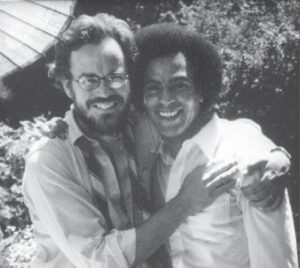
But we have another reason to think about him. As Pinker reminds us, Trivers the scientist has given us insights that are quite simple once they are explained, but eluded great minds for ages. In a brief creative burst from 1971 to 1975, he wrote five seminal essays that invoked patterns of genetic overlap to explain each of the major human relationships: male with female, parent with child, sibling with sibling, partner with partner, and individuals with themselves – not in the physical “self-love” or masturbation sense, but in the stories we tell ourselves, especially as regards our capacity for self-deception.
Full disclosure: in what follows I will be using Pinker’s account extensively as a crib sheet. I have no wish to plagiarise, which is a dishonest practice that unfairly takes the credit for another person’s work, passing it off as one’s own. I do the opposite. I pay homage to Pinker, whose clear description invents the wheel, if you will, and I see no reason to reinvent it with my own rickety spokes and rims more hexagonal than circular.
That said, I no not intend to be Pinker’s slavish devotee. Like Finkelstein, Pinker leans to the right, as do a good many enthusiasts for the evolutionary psychology we will be discussing. It cannot be stated too strongly, though, that there is nothing intrinsically right-wing about the science in question. How could that be the case when, as will be seen, Trivers explores the deep origins of our ability to cooperate with each other, not just ruthlessly compete, as in winner-takes-all capitalism? How could evolutionary psychology be intrinsically right-wing given that it reveals our sense of fairness and justice is based on a firm foundation, and also grounds our profound belief that equality is a key concept (as with socialism) underpinning these ethical perceptions?
In the wake of Foucault, social constructivist thought on the Left has rightly tended to be sceptical of science, dismissing its claims to objectivity as bogus and noting its suspicious corruption in the service of paymasters that include the Military Industrial Complex, Big Pharma, and the now global Child Protection Racket. Nevertheless, it would be foolish and futile to deny that science can be hugely impressive – often difficult to harness safely, admittedly, as with nuclear power or AI, but that is testimony to its reality and potency. It means that if you study chemistry and biology in school you will genuinely be starting to learn how stuff actually works. It’s not just bullshit – which is more than can be said for a lot of what passes as postmodern scholarship these days.
The influence of Trivers’ work on science was vast. His ideas took pride of place in E O Wilson’s Sociobiology in 1975, Richard Dawkins’ The Selfish Gene in 1976, and many other landmark contributions in the next three decades such as Robert Wright’s The Moral Animal (1994) and Pinker’s own The Blank Slate in 2002. The implications for everyone were immense, as Pinker says:
The insight that partial genetic overlap among individuals leads to both confluences and conflicts of interests explains why human life is so intricate – why we love, and bicker with those we love; why we depend on one another, and mistrust those we depend on; why our emotions are powered by moral themes and not just physical threats; why deluded people are certain of their convictions and evil ones convinced of their rectitude.
The ground for Trivers’s revolution had been laid in the 1960s by George Williams and William Hamilton, who focused on the key fact that natural selection is driven by competition among “replicators” (i.e. the basic units of evolution, called “genes” in biology, although other kinds of self-replication are possible, notably “memes” – a term coined by Dawkins – which are culture’s way of making things “go viral”). This implies that the beneficiary of evolutionary adaptations is not the group or even the individual, but the gene. Hamilton drew out an implication: genes can perpetuate themselves by nurturing not only offspring but siblings and other kin, since any genes that benefit a blood relative would, with a certain probability, benefit copies of themselves in the bodies of those relatives.
Trivers’s innovation was to show how the partial overlap of genetic interests between individuals should put them in a partial conflict of psychological interest. The key resource is parental investment: the time, energy, and risk devoted to the “fitness” of a child. Pinker uses this word without any quote marks or explanation, which may lead readers unfamiliar with the technical use of the term to think he is talking about our physical condition, as in “he is as fit as a fiddle” or “fit as a gym bunny”. But what biologists mean is much more inclusive. Yes, it’s about being in good shape, but it’s also about being smart; it’s about your chances of surviving into adulthood with a good chance of having your own children, thereby passing your genes into the next generation. He is talking about the survival of genes over thousands of generations, from when we were all hunter-gatherers, living a very different lifestyle to now, in what is sometimes called “the ancestral environment”. Known to evolutionary psychology more technically as the Environment of Evolutionary Adaptedness (EEA) this was the environment that shaped our brain and the psychological inclinations and desires it harboured, including our feelings about mating, parenting, and social relationships.
It may also seem odd or even obnoxious to use the term “investment”, as though parenting were a capitalist enterprise rather than a labour of love. This sort of language has unfortunately misled many of us gentle, kind, herbivorous lefties into supposing the psychologists who use it must be callous swine in white coats who cold-bloodedly see the whole of humanity as merely self-serving and ruthless. Even Dawkins’ provocative title The Selfish Gene inadvertently took us quite a way down that road, which he later regretted, along with other aspects of his eloquently arresting style. Ironically, he wrote too well for his own good!
Nevertheless, the concept of parental investment is a truly powerful and necessary one for anyone who wants to understand why we are as we are. What follows, based on Pinker’s summary of Trivers’ foundational work might seem far-fetched and (if you are versed in the standard objections) “reductionist” or “essentialist”, or “genetically determinist”, but my advice is don’t knock it before you really understand it. The name may be Trivers, folks, but he ain’t trivial, and his understanding ain’t superficial, so listen up and listen good. Pinker again:
Parents have to apportion their investment across all their children, each equally valuable (all else the same). But although parents share half their genes with each child, the child shares all its genes with itself, so its interest in its own welfare will exceed that of its parents. What the parent tacitly wants – half half for Jack, half for Jill – is not what Jack and Jill each want: two thirds for the self, one third for the sib. Trivers called the predicament parent-offspring conflict. Its corollary is sibling-sibling conflict: every offspring has an interest in its siblings’ welfare, since it shares half its genes with the sib, but that interest is outweighed by the twofold genetic interest it has in itself.
Jill may not even exist yet for Jack and his parents to differ over her welfare. Baby Jack may want to suck his mother dry, while Mom wants to keep part of herself in reserve for unborn Jill and other future offspring. The conflict is waged throughout the lifespan: in ailments of pregnancy (like pre-eclampsia and gestational diabetes), postpartum depression, infanticide, cuteness, weaning, brattiness, tantrums, rebelliousness, sibling rivalry, and struggles over parental attention, support, and inheritance.
Not that toddlers are ever consciously battling on behalf of their own genes, of course, and especially not in the mathematically exact and calculated way that Pinker’s words might suggest. Rather, it makes more sense to think of these calculations as the scientists’ way of bringing precision to bear on what drives us unconsciously, by instinct.
It may help to consider sibling rivalry for a moment, which Pinker mentions above. Unlike parental investment, this is a scientific concept that is also familiar in everyday language and life. Unless we are an only child, most of us will have experienced it directly with our own brothers or sisters. Often it can be quite extreme, leading to bitter and toxic quarrels in childhood, sometimes leading to a lifetime of enmity and resentment, especially when there is much at stake in rich and powerful dynasties, fighting over who will inherit the crown or the business empire. Such has been the stuff of legend from the Bible’s Cain and Abel, or Isaac and Ishmael, to Game of Thrones and Succession in our own day.

My older Big Brother and I were too far apart in age (six years) for intense rivalry in childhood. He was so clever, sophisticated, strong, and athletic there was just no contest. He was awesome to me and my parents alike. I hero-worshipped him. If there were to be a battle between us over who was more worthy of parental investment in our future, he should have won hands down.
Except it wasn’t that simple. Bro was actually quite jealous (as he confessed to me decades later) because I somehow stole a lot of parental attention. Part of it was inevitable of course. I can claim no personal merit whatever in being younger and smaller, which automatically made me cuddlier and cuter! But additionally, unlike my slightly too self-assured and rebellious brother, I was also pleasantly “low maintenance” for Mum and Dad. Bro must have been heartily sick and tired of hearing how I was no trouble at all, a Little Angel! Looking back, there must have been times when he could cheerfully have murdered me. Well, thanks, Bro, for not yielding to that temptation! Until he died a few years ago we remained in wary but amicable correspondence with each other, and he will always be my hero.
What we had each managed in childhood was to win parental investment through different self-marketing strategies: Bro’s fitness in evolutionary terms was never in any doubt. He was an Alpha male all the way. So instead of trying to compete by being fitter in the crude understanding of the “survival of the fittest” – tough, and dominant – I found myself slotting smoothly into a different evolutionary niche, that of a useful, well functioning, Beta male. Rather than making my mark as a leader, I would be the “nice” sibling, adorable as a kid and seen by Mum and Dad as a gentle and cooperative child, and also one with a viable future. They could be confident I would become a reliable worker, the sort of loyal team player employers are keen on. Fit, as it were, for survival in the workplace.
Or if I were to be any sort of leader it would be in some sort of “caring” occupation, or a quietly scholarly role – I was always “bookish” enough to suggest that possibility. Mum often called me “my little professor”, and once she told me she thought I might become a missionary, taking Christianity to the empire Britain still had in those days, perhaps even becoming a bishop! She also thought I would make a good husband and father one day. Plenty of girls would love a “steady earner” – a nice, regular guy who would stick around though thick and thin and be great with the kids. Genetic mission accomplished!
Well, things don’t always go to plan, do they? A key take-away is that just as weather forecasts these days are based on scientific observations and modelling but are still not entirely reliable, neither are predictions about people. There are just too many variables, including random unknowns. Our futures are not determined by our genes, only influenced by them. This doesn’t mean evolutionary psychology is useless bollocks. We would be foolish to ignore its insights, just as no wise mariner would ignore a storm warning.
Parental investment, Trivers explained, is also implicated in the battle of the sexes. When Darwin introduced the concept of sexual selection, he observed that in most species, males compete and females choose, but he had no idea why. Trivers explained the contrast by noting that in most species the minimal parental investments of males and females differ. Pinker again:
Males can get away with a few seconds of copulation; females are on the hook for metabolically expensive egg-laying or pregnancy, and in mammals for years of nursing. The difference translates into differences in their ultimate evolutionary interests: males, but not females, can multiply their reproductive output with multiple partners. Darwin’s contrast can then be explained by simple market forces. And in species where the males invest more than the minimum (by feeding, protecting, or teaching their offspring), males are more vulnerable than females to infidelity (since they may be investing in another male’s child) and females are more vulnerable to desertion (since they may bear the costs of rearing their mutual offspring alone).
In another landmark, Trivers turned to relations among people who are not bound by blood. No one doubts that humans, more than any other species, make sacrifices for non-relatives. But Trivers recoiled from the romantic notion that people are by nature indiscriminately communal and generous. It’s not true to life, he thought, nor is it expected. Instead, he noted, nature provides opportunities for a more discerning form of altruism, in which there is an exchange of benefits. One animal can help another by grooming, feeding, protecting, or supporting them, and is helped in turn when the need arises. Everybody wins.
Trivers called it reciprocal altruism, and noted that it can evolve only in a narrow envelope of circumstances. That is because it is vulnerable to cheaters who accept favours without returning them. The altruistic parties must recognise each other, interact repeatedly, be in a position to confer a large benefit on others at a small cost to themselves, keep a memory of favours offered or denied, and be impelled to reciprocate accordingly. Reciprocal altruism can evolve because cooperators do better than no-cooperators. They enjoy the gains of trading surpluses of food, pulling ticks out of one another’s hair, saving each other from drowning or starvation, and babysitting each other’s children. Reciprocators can also do better over the long run than the cheaters who take favours without returning them, because the reciprocators will come to recognise the cheaters and shun or punish them.
Reciprocal altruists must be equipped with enough brain power to recognise and remember individuals and what they have done. That helps explain why Homo sapiens, the most social species, is also the smartest one; human intelligence evolved to deal with people, not just predators and tools. We must also be equipped with moral feelings that implement the tit-for-tat strategy necessary to stabilise cooperation. Sympathy and trust prompt people to extend the first favour. Gratitude and loyalty prompt them to repay favours. Guilt and shame deter them from hurting or failing to repay others. Anger and contempt prompt them to avoid or punish cheaters.
Language has played a distinctive and critical role in this reciprocal altruism. Because we are language users, any tendency of an individual to deal fairly or cheat, lavish or stint, will quickly become known to others. Quite literally, word will soon get around about their reputation. And because our reputation affects our ability to secure favours (it is all about our credibility and “credit rating”, stretching from our buddies to our bankers) it will be in our interests to have a good reputation. Most of us find the easiest way to do that is to pay our bills and buy our round at the pub without trying to wriggle out of such obligations at every opportunity.
But that’s not the end of the story. The most profound aspect, Trivers’ greatest discovery, is where he goes next. We are all familiar with the notion that we sometimes fool ourselves. Self-deception, like sibling rivalry, is a frequent theme in literature, especially the potentially tragic consequences of failing to “know thyself”, as in Shakespeare’s King Lear. What Trivers uniquely added to the story is how self-deception evolved, and how it can work to an individual’s advantage rather than always ending badly. Indeed, unless it conferred some benefits it would be hard to explain why so many humans have become so good at it: if the consequences were always tragic, those who routinely deceived themselves, becoming completely detached from reality, would have been seen as idiots, or crazy. They would never have found sexual partners who wanted to have children with them, and any genes promoting the self-deception trait would have died out.
The best thing of all (from an evolutionary standpoint) would be to get people to help us without returning their assistance, but also without damaging our reputation. So as well as developing a co-operative instinct, we also evolve the capability to deceive other people with lasting success.
This, Trivers realised, led to two further steps in evolution. The first is that we develop strategies for spotting this deception. Second, we develop even more sophisticated methods to ensure our deception evades detection. This escalating arms race between deception and detection culminates in the supreme form of deception. We deceive ourselves.

Danny Finkelstein tells us that Trivers, in his book The Folly of Fools (2011) explains that when we knowingly lie and deceive we often worry about being caught out, and our nervousness gives us away. Other people can see through it. They are watching keenly because they have evolved to watch keenly. So we have evolved, in retaliation, a way to avoid being caught out: we deceive ourselves. Then, a stray glance or a nervous move won’t let us down. If we truly believe we are being honest, we will be able to look others straight in the eye and speak with passion and conviction.
This routinely works brilliantly for the ardent young man with an ’ardon, eager to get a chaste girlfriend’s knickers down. All he needs to do is believe he loves her, he’d die for her, he’ll be hers till the end of time, till the stars cease to shine… That strength of belief comes all too naturally for many guys, even if “the end of time” turns out to be the end of the month, or whenever the first quarrel or inconvenience comes along. If it’s that shallow, of course, reputation will ultimately suffer, but there are plenty of entirely sincere serial Prince Charmings for whom it always works like a charm.
My first encounter with this theme would have been way back in the 1970s when I read The Selfish Gene. Trivers wrote a foreword in which he included a couple of sentences on self-deception. I have no memory of this (Pinker’s article reminded me) and I am sure the significance of a brief few lines would have escaped me at the time.
Much more important to me was the appearance of Wright’s The Moral Animal a couple of decades later, which gives an extensive account of Trivers’ insights, especially how the simple basis of reciprocal altruism (“You scratch my back and I’ll scratch yours”) grew into deep moral convictions as to what constitutes fairness and justice, underpinning not just personal exchanges of favours but also much bigger concepts, such as the Golden Rule (“Do as you would be done by”), the Rule of Law, and even the high concept of Human Rights.
When I encountered Wright’s book in the 1990s, it struck me as the most profound non-fiction work I had ever read, beating Darwin, Freud, Marx, you name it, and leaving even great poetry, drama and novels struggling to match its meaning for me. Would I still recommend it today? Absolutely, except for the fact that genetics has taken giant leaps forward in recent times. Trivers’ insights are still valid (just as Darwin’s are still foundational) but these days I would choose a book, or perhaps a few expert podcasts, that goes into the co-evolution of genes and culture. No serious scholar would claim these days that the human story is just about either the genes we inherit or the culture we grow up in, shaping our learning and behaviour. The story is one of both/and not either/or.
On that basis, I am guessing the best fairly recent book would be The Ape that Understood the Universe: How the Mind and Culture Evolve, by Steve Stewart-Williams, 2019. I haven’t read it yet, but the publisher’s description and expert reader recommendations make it a tempting one to put on my list to get around to. I’d love to hear from any heretics here who know this book already and can give us their verdict, or make other recommendations.
New page made for https://wiki.yesmap.net/wiki/Joan_Nestle , a queer lesbian writer who would become associated with the “pro sex” wing of feminism and was a target of anti-porn feminists during the 1980s “feminist sex wars.”
Nestle is interesting particularly for having lived through McCarthyism, and having been part of lesbian culture during the 50s and 60s. Very different times, where lesbianism was far less accepted compared to the 70s and beyond…
Nestle wrote openly about her sexual longings for adult women in her childhood. Very honest / authentic, and a very good writer.
Huw Edwards is back in the news, having started his very own blog in an attempt to make a comeback. Don’t expect content similar to that of Tom or I, but good on Huw for not allowing himself to be burned like a witch!
Huw Edwards’ blog – https://thehuw.substack.com/
My take – https://www.brianribbon.com/home/emma-jane-taylor-and-the-huw-edwards-comeback
I’ve just paid a quick visit. Edwards is astute, as we might expect, of the present state of British politics in a piece on the impending arrival of Andy Burnham in the top job.
His “remorse” over his “crimes” in another piece, on the other hand, is well cringe in my view.
I wonder if a certain other new blog we’ve been hearing about will now denounce “the Edwards classes” along with the Epstein ones?
I should add that I have now read your piece as well, Brian. I like it, including the feisty finish about MAPs getting out there, loud and proud in people’s faces on every available forum.
I keep getting ‘dead pedophiles dont reoffend’ on my fb feed. Can someone explain how this is allowed exactly?
The first issue of paederos is out. Go check it out!
https://paederos.com/2026/06/29/paederos-issue-1/
As described,
A new magazine just published, with few names I recognize except for Ally Kotetsu, whose work and overall approach I’m generally very supportive of and have praised on this blog… So, that means new names, new authors, cool artwork and layouts in this new journal issue. From what I’ve read, I’m not keen on the 1st piece at all, but the more personal stories titled “My Story” (page 3) and “And I’ll Love Again” (page 10) were good reads – emotional and compelling.
Check it out and see what you think, HTOC readers!
A new magazine has to be good news, not least at a time when my time is very limited and I am struggling even to get the occasional blog out.
I’ve just had a quick glance and seen that the first article, the one Prue is not so keen on, is against Epstein and “the Epstein class”. Heretics at HTOC will know that I have defended Epstein against the allegations based on the weakness of the evidence against him and the demonstrably mendacious, gold-digging opportunism of the leading allegator.
Nevertheless, I’m fine with a presumably young generation of radical activists taking a passionately contrary view. That’s great. Go for it!
No CSA-suicide association: DOI 10.1016/j.lana.2026.101531
Canada: censorship or ban for choice: https://www.medscape.com/viewarticle/canada-introduces-safe-social-media-act-protect-children-2026a1000lj9?form=fpf
“Iatrogenic harm” during “condoned consent” to CSA
DOI 10.1016/j.chiabu.2026.108181
AI-based Cleveland: DOI 10.1016/j.childyouth.2026.109106
Made page for PIE Executive Committee member https://wiki.yesmap.net/wiki/Peter_Bremner , using publicly available info.
If there’s anything readers here would wish to see added, any details about his life that you’d like to see become part of the historical record, let me know.
Next up is Michael (“Mickey”) Burbige…
Great to see this page, Prue, although the available public info is heavily biased towards the negative, for obvious reasons.
My own recollections of Peter can be drawn on to redress the balance, so let me remind you if you missed it that I wrote about him here in 2019, soon after his death in that year: https://heretictoc.com/2019/07/07/are-we-making-useful-idiots-of-ourselves/
I also delivered a eulogy at his funeral. I knew it would be an emotional occasion for me. Partly to help hold myself together, I wrote down every word of my speech beforehand, and I saved it afterwards. I’ll send you a copy by email as there could be one or two details you might wish to include in your Newgon Wiki “yesmap” page.
Here is what I wrote at Heretic TOC, along with a couple of updates and added info:
California is a real hell hole . Dad abuses his daughter she commits suicide age 18 gets one year jail have consentual sex with a 17 yr old and you get far,far longer… As for murder that us also deemed a lesser crime. Evidence? Yes l am reminded of the deaths of marvin gaye and dominique dunne
Your “Freud vs. victimology” paper sounds incredible.
Masson, Jeffrey Moussaief. 2026. “Trauma within Psychoanalysis Was to Become My Personal Trauma.” International Forum of Psychoanalysis, June, 1–6. doi:10.1080/0803706X.2025.2575781.
Abstract
I had the privilege of working with Sigmund Freud’s daughter, Anna Freud, in her house in Hampstead. For reasons that have always been a bit obscure to me, she allowed me to see, copy, and eventually edit and translate all the unpublished letters from her father to his friend Wilhelm Fliess. She went further: she allowed me to work at her father’s desk, where I found a series of letters having to do with Sandor Ferenczi’s last paper, the extraordinary essay about child sexual abuse he called “Confusion of tongues between adults and the child.” These unpublished letters make it very clear that Freud was very upset that Ferenczi was returning to what he called his “initial error.” Ferenczi read the paper out loud to Freud. Later Freud wrote to his disciples that “Ferenczi must NOT be allowed to give this paper.” These letters and Anna Freud’s decision to allow me to publish them (when she was under pressure to forbid me to use any of the unpublished letters, either in the edition I had prepared of the Complete Freud/Fliess letters (Masson, 1985), or in the book I was writing which became The assault on truth) has always been something of a puzzle. I believe I have solved the riddle. This is what I write about.
Note that this was published June 24th, 2026 – literally hot off the press!!
The author, Jeffrey Masson, is famously controversial. As his author description reads:
Jeffrey Moussaief Masson was a professor of Sanskrit at the University of Toronto when he applied for psychoanalytic training. He graduated in 1979 as a fully trained clinical psychoanalyst.
Masson met Anna Freud often in 1980 and she gave him access to the complete letters of Freud to Fliess, and gave him permission to edit them and translate them for Harvard University Press. When the New York Times reported on a paper that Masson gave in New Haven, where he said that Freud made a historic error in giving up his early belief in the reality of early childhood abuse, Eissler and other analysts (actually all analysts) were aghast, and Masson lost all his positions. It was a difficult time for him, but he turned to writing about the emotional lives of animals and several of his books became international best-sellers – see When elephants weep, and also Dogs never lie about love. (You can see a full list of his thirty books on Google.) He now lives in Sydney, Australia, with his German wife, Leila, an integrative pediatrician, and is writing a final (?) book about what is wrong with our species. You are welcome to email him at his home address.
Another very good find, Cyril. :p
Why are you so surprised? Freud betrayed victims is a banal theme in victimologic historiography.
Schrödinger case: DOI 10.1002/bewi.70017
“cultural silence around sexuality can redirect curiosity to risky digital spaces”: DOI 10.1007/s13178-026-01381-y
“some children are becoming sexually active before the age of 15″—“Shocking!”: https://youtu.be/Jx93KKWkVnk
Victimology in Zionist propaganda: DOI 10.1177/08862605261451870
False allegations: https://www.thenorthernecho.co.uk/news/26214336.former-shildon-teachers-warning-false-abuse-allegations/
“two years for …possession of the paedophile manual”: https://thehaveringdaily.co.uk/2024/04/23/london-news-east-london-man-jailed-for-offences-related-to-children-including-downloading-a-paedophile-manual-to-give-advice-on-how-to-commit-offences-against-children-as-young-as-two-months/
No positive CSA-alcoholism association: DOI 10.1016/j.bpsc.2026.06.004
Kids prefer prostitution to institution
DOI 10.1177/00938548261459661
Predictors of punishing kids for sex: DOI 10.1177/10775595261463204
I’m very glad to see the first link, Cyril, about physicist Erwin Schrodinger. As readers here may know, I used publicly available information to do a large “fact check” piece on Erwin’s alleged “Lolita complex” a long time ago. (See https://wiki.yesmap.net/wiki/Erwin_Schrodinger ).
I found, to my genuine shock, that the Irish Times had blatantly and very provably lied about Erwin. And it was evident by checking the very same sources they cited in their article!! Absolutely sickening and strange behavior – these “journalists” disgrace the profession and should be ashamed of themselves – tarnishing a dead man’s legacy by lying about him…
Sad that the body of this research article is in German, but great that the researchers’ got access to his private diary “Ephemeridae,” which would only be available through an in-person archive.
Perhaps I’ll run their piece through a translator; it seems the kind of thing that we’d all benefit from being able to read and learn about. It’s a massive, sad scandal that seriously impacted Schrodinger’s legacy, and it’s only right and proper that provable nonsense like this gets called out.
Great find, Cyril.
I’m always said that my comments are useless, what a pleasure to know that someone is reading them—thank you, Prue.
So, I’m back down from the mountains after a splendid weekend’s hiking. Maybe I should have brought back some impressively engraved tablets of stone, bearing commandments for all you heretics to behave yourselves!
It’s certainly been lively in my absence, hasn’t it? Perhaps I should shut up and go away more often, allowing others to step up to the plate when significant debate is called for. Several heretics have done that, so congratulations to you all, and to Condemned for the combative provocations that sparked it all off.
I would never wish to tame the impressive energy and commitment shown on all sides in these exchanges, so there will be no commandments to Cease and Desist. Gentle suggestions are my preferred mode here, and I do actually have a few of those.
Rather than Ten Commandments, we will be sailing on the Seven Cs. Before the weekend I encapsulated this blog’s contribution “in these hard-to-live-in times” as being about Community, Consolation, and Contemplation.
Numerate heretics will note that we need a few more Cs to make the significant Seven. The other four have long been amongst my comments on Heretic TOC’s About page, as an afterthought to the main mission statement. These are the advice that comments should be Concise, Courteous, Coherent and Content-rich.
Unfortunately, the energy and commitment I have commended does tend to be at odds with these four Cs in the heat of battle, especially the first two.
Here’s a tip: brevity is key to effective rhetoric. Nobody is interested in interminable posts. They are not persuasive. They serve only to signal the probable desperation or even madness of the writer.
Oops, this is getting a bit long… 🙂
Set a word limit—automatic.
There’s a case for that. Let’s see if others express support for it.
In response to Condemned’s lengthy input I will focus with relative brevity on three key aspects.
1. Rind’s work. Arguably, the most significant and distinctive contribution of his famous 1998 meta study with two colleagues was its use of regression analysis that disentangled real causes of harm to children from supposed ones. The study never claimed that adverse child experiences are generally not traumatic; they often are. Rather, the data showed that adverse early family experiences, including neglect and non-sexual abuse are nine times more likely to be traumatic than sexual ones. The authors also hypothesised that if acts involving only willingly engaged children were studied on their own, they would be revealed as not harmful at all and might well be a positive experience. Sandfort had already demonstrated the truth of this and subsequent research (notably but not solely from the Finnish Child Victim Survey) has strongly supported it. It has already been pointed out that Rind’s study is validly representative because the college sample results are consistent with wider population (national) ones and that the study has been successfully replicated. I would add that leading research psychologists do not doubt the quality and validity of the 1998 study. As Professor J Michael Bailey, a scientist of stellar reputation, put it to me, where statistical research is concerned, Rind “is simply the best”. It need not surprise us that Rind is brilliant when we realise that he is also an international chess master. Even James Cantor, academic champion of the Virtuous Pedophiles, acknowledge Rind’s expertise – as indeed do Nick Devin and Ethan Edwards, founders of VP.
2. The clinician’s fallacy. No disrespect to psychiatrists, but many are drawn to the profession in an effort to understand their own mental problems. A case, perhaps, of “You don’t have to be mad to work here, but it helps”? The trouble with that is that I don’t think it does help, because those who work with traumatised people can easily be traumatised themselves if they are already emotionally vulnerable – their situation is comparable to that of doctors and journalists in war zones, who are prime candidates for PTSD, just as soldiers are, but with added prior vulnerability. In these circumstances they can all too easily become like the hammer that sees every problem as a nail. MAPs, especially, working as therapists are all too likely to latch onto a single cause – CSA – as the root of all evil, especially if they have been driven half mad by their efforts to dissociate themselves from their own impulses and project the “badness” of them onto others. My language here is deliberately somewhat Freudian because Freud’s more viable concepts are still with us; but we should note that he was no scientist in Popper’s sense. Likewise, big names like Melanie Klein and Donald Winnicot gave us much wisdom but also much obscure and misleading speculation. Above all, because the psychanalytic tradition has valued intuition over verification, its fallible human practitioners have been woefully vulnerable to selection bias. Their lives these days are full of patients who (no doubt often quite sincerely) attribute their ills to CSA on the basis of availability bias. Because CSA is constantly in the media, it has become an easily available, all-purpose explanation of their gambling addiction, marriage breakup, etc, etc. And clinicians keep falling for it. Less “available” to them – not present in their consulting rooms or their thoughts – are the kids who lived happily ever after their “CSA”. These tend to be present mainly just in dry sets of statistics, such as the Finnish study, rather than in vividly available actual patients. This is the clinician’s fallacy, or cognitive bias.
3. Consent. I will not dwell on this, as other commentators have made good points. I will just note that Finkelhor’s criticism of Sandfort’s work was based on moral rather than scientific grounds. Finkelhor failed to lay a glove on the latter. In a weak circular argument, he asserted the wrongfulness of child-adult sexual contacts (even when the child gives de facto consent) on the basis of its alleged harmfulness. But how do we know it is harmful? Because it is wrong! It must be wrong because it’s against the law, and there wouldn’t be laws for nothing, would there? Well, maybe there might, as with the anti-gay laws not so long ago in the US, UK, etc. Finkelhor failed to get to the root of the matter. He failed to establish an empirical link between consensual child-adult sex and harm.
Moral panic does not influence art: DOI 10.1177/00222429261464934
No significant CSA-dissociation correlation
DOI 10.1016/j.ejtd.2026.100712
“beaten into a coma”: https://www.facebook.com/story.php?story_fbid=1450968247067378&id=100064626493881
‘financially coerced “self-produced” child sexual exploitation’
DOI 10.1016/j.childyouth.2026.109130
Incest is not compulsory
DOI 10.1016/j.amp.2026.05.009
If sex offenders are good seducers why are they accused of substituting wives with kids as more available for them?
AI predicts crime: DOI 10.1080/00224499.2026.2686406
Forced to steal by pedohunters: https://www.facebook.com/glasgowtimes/posts/a-vulnerable-pensioner-wrongly-accused-by-paedophile-hunters-was-so-afraid-for-h/1454403783391925/
Teen sex myths: DOI 10.1177/09731342261457692
Cops pretended to be kids: https://www.chroniclelive.co.uk/news/north-east-news/hexham-paedophile-snared-after-sending-34144346.amp
“Inflammatory bowel disease is not significantly associated with childhood abuse. Neither Crohn’s disease nor ulcerative colitis showed a significant association with any form of abuse”: DOI 10.1177/15248380261460029
No mandatory reporting
DOI 10.1007/s10610-026-09679-8
“beaten to death by passer-bys”: https://readovka.news/news/100447/
Killed by teens: https://www.cuatro.com/cuatroaldia/sociedad/pedofilo-menor-matar-paliza_18_2219700208.html
Official apologizes for having not enough deaths: https://www.irishexaminer.com/news/arid-41864760.html
I found this site of yours out of nowhere. I am a MAP and I have a degree in psychology and psychiatry and I am many years younger than you. I have known about the MAP universe for more than twenty years and in recent days I have read hundreds of comments and articles on your site.
I would like to give you my personal opinion: I believe that what you are doing is absolutely disturbing and what destroys me the most is finding so many pedophiles like you who share your same idea.
I am a MAP and I am not happy, my life is absolutely horrible but I would never dream of thinking or trying to convince anyone of the things you talk about.
The first post I read on this blog was the one about Carroll.
As much as my idea is very similar to yours, I cannot help but notice how you and hundreds of other people in this blog lack the basic concept of the Carrollian vision – that is, the idea of a perversion – orientation sublimated into something deeply artistic and entirely linked to the loss of innocence.
Carroll knew – or perhaps he didn’t know – that he did not want to reduce everything exclusively to sexuality. He was a mediator between desire and form. It was an innocence contemplated by an adult who knew he could not possess it without destroying it and that is what a MAP should be.
Not anything you have written or done over these years.
I would never want to feel represented by you or by your words or by this absolutely useless and ignorant struggle – from a psychological, historiographical, anthropological and artistic point of view.
You do not represent me and people like you will never represent me or the few MAPs “like me” who I really hope still exists. Your conception of “minor” is absolutely psychiatric, and it shows – I know because I am like that too – that everything in you stems from extreme repression.
It also disturbs me that I found no comments or any trace regarding the 2 years in prison you served for buying illegal videos. There is no art in you and in this struggle of yours there is no struggle at all, there is only you at 70 years old man who – in my opinion – hopes for a world where your sexual freedoms are not condemned.
News flash: it seems to me that you know absolutely nothing about how a child’s mind works and in no way can it be “brushed” by your sexual need without automatically being destroyed.
I don’t know if you will accept this comment but somewhere you said to be “critical”. I have been.
I wanted to leave something before I leave. I am glad that many people follow you, but honestly, I would rather die than be associated with a person like you.
>I don’t know if you will accept this comment
Sure, no problem at all! It’s late at night as I read this so I will not attempt a fuller response just now. Maybe tomorrow.
He does not seem to want your response, moreover, no argumentation is offered here to be discussed.
>I cannot help but notice how you and hundreds of other people in this blog lack the basic concept of the Carrollian vision – that is, the idea of a perversion – orientation sublimated into something deeply artistic and entirely linked to the loss of innocence.
Condamned by his own distortion, There are far fewer than “literally hundreds of other people on this blog.” And Carroll’s vision was his (and yours) not literally millions of other MAPs or not so ‘innocent’ AAMs ongoing Worldwide throughout history.
Pup, you wrote:
>There are far fewer than “literally hundreds of other people on this blog.”
It would certainly be true to say that “Condamned” has no basis for his opinion that ” hundreds of other people in this blog lack the basic concept of the Carrollian vision”, for the simple reason that only a handful of commentators here have written about Carroll and any vision he may or may not have had. Neither “Condamned” nor I can really know what those who have remained silent think about Carroll.
However, I wouldn’t want anyone to be given the impression that only a handful of people visit Heretic TOC. In the first five completed months of this year, page hits were running at an average of over 500 per day and I imagine most people on most occasions would visit only the current blog (i.e. just one page), so there are probably well over 400 individual visitors per day.
On 2 June there was a sudden spike to 6,688 page hits. I have no idea why! Maybe Heretic TOC was mentioned on Joe Rogan!
Thank you, “Condamned”, for your forthright expression of opinion. All perspectives are welcome at HTOC, so I have no problem with that. In fact, a lot of space has been given in the past to the views of “Virtuous Pedophiles”, many of whom appear to share your distaste for the heretical stance taken here.
So, what can I usefully say? In another comment here, Cyril noted that you had not presented an argument. In other words, you were just expressing your feelings and opinions. That’s fine, but of course one cannot present counter-arguments against an argument that has not been made! One can only express contrary feelings and opinions, which I do not think would be helpful.
I will say a bit about Carroll, though, because you say he sublimated his sexuality through his art. It’s a frequently made claim, but how does anyone know he did not express his sexuality directly? After all, Victorian society was once a byword for bourgeois hypocrisy: countless were the respectable gentlemen who preached virtuous chastity (many of them literally preached: Carroll, aka the Rev Charles Dodgson, was a clergyman) while availing themselves liberally, albeit discreetly, of the services of “fallen women”. And on the streets of London, which he often visited, and which was just a short train journey from his home in Oxford, there were many little maidens more than willing to earn a a penny or two by offering their favours to a prosperous-looking, well-dressed man about town.
Let’s not forget, too, that even in Oxford, where he had to keep up respectable appearances, Carroll’s art was not necessarily “pure” and “innocent”, involving, as it did, taking erotic photographs of naked little girls — acts which would see him condemned as a pornographer today, and put on the Sex Offender Register.
As for your personal views, “Condamned”, they clearly come from a place of understandable unhappiness and of anger I would say is misdirected. Sadly, though, I feel it wouldn’t help for me to explore that thought further.
I’m replying to everyone with this post.
I want to say exactly what I said at the end of my previous message: I left that comment as a personal warning, a simple opinion, and not necessarily to get a response. In fact, I expected it might not even be accepted, but I wanted it to be read by the author of this blog as a simple personal closure. I appreciate having received it, mostly for the way you expressed yourself.
You don’t need to read my opinions to understand that I don’t fully accept myself and that I don’t like myself, since I didn’t choose to become this way. I saw one of your interviews on YouTube and I can only congratulate you for showing your face and use your name. It’s clear that you have nothing to lose and that for you this thing has become a personal life model to follow and I really respect that. I just don’t respect your vision.
What we don’t share is the sensitivity toward a certain type of sexual conception, which, from the many comments and posts I’ve read on this blog, seems to be completely lacking. That’s why in my comment I mentioned Carroll.
I know VIRPED and I was part of that community for a short period, but even there, I didn’t share many of the things those users shared.
I never looked into how many people are on this blog; I limited my interactions to about thirty posts read and based my conjectures entirely on the numbers from the comments themselves.
Whether there are 500, 5,000, it makes no difference to me. When I wrote “how you and hundreds of other people in this blog lack the basic concept of the Carrollian vision,” it was a simple hyperbole since I took for granted that all the people who comment on your posts (150–200 users per post) agree with you.
Regarding Carroll: everything you say is probably correct in some form, but there is no evidence about it.
I am a fairly intense scholar of everything concerning Carroll and the era in which he lived.
I spent really a lot of time exploring the Leach / Wakeling – Gardner / Morton debate and I have also met some of the official authors from both sides of the theories.
I am also quite knowledgeable about the Victorian era, and for this reason, I believe that many of the arguments that have been inserted here come from biases and not from actual direct knowledge of that period.
Whether Carroll had the opportunity to abuse a minor or not is uncertain and will remain so forever. The evidence tells us that it didn’t happen, and there are no testimonies from his child-friends who spoke of him in an ambiguous way – although as a MAP, and you know this too, it is perfectly reasonable that he built a perfect mask for himself.
I only spoke about what is known, and what is known is exactly what I talked about.
The sublimation I speak of in Carroll is not a generic “claim.” It is objective.
You can read Isa Bowman’s book, written a year after his death, where she recounts an event when she was 9 years old and which, for a MAP, is a clear triggering moment where Carroll has a small neurosis after making her cry and, after that, he kisses her passionately – her own words in her first and last book.
So I didn’t take for granted that in Carroll there was what already exists in us, and I certainly didn’t hide the possibility that he might have abused children. We simply don’t know.
It’s the way you spoke about him that bored me and led me to write that comment.
I would like you to understand that my entire argument was based on a simple fact: in this blog and in your articles, I have only seen a rambling, compulsive, sad, and desperate attempt not to fight for “rights” that in my opinion we shouldn’t have, but rather to try to convince that small world you’ve created for yourself that for you and for people like “us” there is still hope and you do it by putting forward a logic that is not psychology, not psychotherapy, not anthropology, and not biology.
I’m glad if someone believes in it, if someone believes that there is hope. I like to think that there is hope, but it doesn’t belong to your posts or to the things you talk about. In what we are, for me, there is no logic. We don’t have a “sexual orientation.” But I won’t get into psychoanalytic concepts. It’s simply my idea against yours. Everyone is free to do what they want.
For me, a MAP shouldn’t be this, but I understand why this blog attracts so many people.
People are angry. I am not angry, and I don’t want to be represented by you – I use this term because I’ve read several times somewhere that “Mr. O’Carroll represents us.”
No, I don’t want to resemble you, and I don’t want to fight for a battle that doesn’t exist.
If many MAPs went to therapy, perhaps today many of them would be happier and more at peace and perhaps many of them would discover in the long run that they aren’t really MAPs at all, but have simply identified with a very different fear.
I’m not here for a debate or anything else. If someone wants to reply, they can, but knowing the subject, I know we could talk about it for ten years without stopping and we would always have different things to say and tell each other. Good luck.
I find this more interesting than your first post, Condamned. Just a couple of short specific points first:
>I took for granted that all the people who comment on your posts (150–200 users per post) agree with you.
They do not, and I wouldn’t want this forum to be a mere echo chamber. Your assumption was actually a stonkingly big one. What made you think that was wise?
>I’ve read several times somewhere that “Mr. O’Carroll represents us.”
It is not something I have ever claimed, except when I was Chair of PIE and democratically elected to represent the view of members who had signed up to our constitution, which included a statement of position and aims.
If there are heretics who feel I represent them in some measure, that’s fine by me, but I totally respect that many do not and they are entitled to say so, including you.
As for hope, the days are long gone when the age of consent concept could be seriously challenged, as it was in the Netherlands, where law reform succeeded for the last decade of the 20th century. I recognise that the gender revolution has tilted decisively, at least for the foreseeable future, towards acceptance of what we can broadly call feminist orthodoxy (a million miles from the far more freedom-oriented spirit of early Second Wave radical feminism).
Rather than hope, I think more these days along the lines of three C’s: consolation, community, contemplation. We all need to find a way of living amidst the hostility. I know from the people who write to me that there are many who find value in the idea of a MAP community and the conversations we have here and on other forums.
Forgive me for not replying to this as well, and forgive me for slightly attacking you in a previous comment – I did it because I felt attacked.
I’ll answer your questions.
Nothing made me think it was wise. I simply didn’t think about it. And I don’t see the problem with this “gigantic” mistake. I just said that not having access to your numbers, I used the few I had available. As I already wrote, 500 people or 5,000 doesn’t change what I said.
I didn’t say you said it. I said I heard it said “somewhere.” Thank you for respecting my decision not to be represented or connected to you in any way.
I agree. In my case, I would be against a MAP community, even though I myself am a MAP. But I imagine many people would be happy with it, even if they risk being killed in the dead of night.
Condamned, I think you’ve internalised (come to believe) the narrative of the dominant discourse, which is a jumble of lies, age-old myths, prejudices and unfounded fears. It might help you to read the works of the clinical psychologist Frits Bernard, or those of Theo Sandfort, or those of Bruce Rind.
ConfusedMan, you seems confused. I’m reading is a standard rhetorical move. I am a psychiatrist and psychologist and there is no propaganda here. Your ideas are pro-pedophilia ideological concepts, and even though I am and remain a MAP, I know perfectly well what my rights are. Bernard said nothing new. Sandfort was a generic researcher who said for much of his life that he was studying a non-representative group of boys and never claimed to be pro-pedophilia. Rind and his meta-analysis on child abuse, conducted on very few university samples, created a minimization of harm. These are the few names that have always been used as rhetorical ammunition. There is no valid sexual consent with adults. There is no dominant discourse. It is child protection and power imbalance. This is my view, and I am not here to fight your opinions.
If you want some advice: you should read Berne, Winnicott and Klein to understand how a child’s mind works.
Judith Herman. One of the greatest figures in trauma psychiatry. Try to understand why “moral panic” is nonsense. Anna Salter, who worked on sex offenders, victims, and predatory dynamics. She dismantles all the strategies of manipulation, rationalization, and self-absolution employed by ‘heretical’ MAPs over the years, and she does it perfectly, in concert with others. Read Briere, Judith Cohen, Deblinger, Mannarino, Putnam, Summit. All essential psychiatrists. Read David Finkelhor, sociologist and leading expert on child victimization.
The critique of Rind is made by Whittenburg, Tice, Baker, and Lemmey. They identify seven methodological problems in Rind’s work, including limited samples, coding issues, and other such flaws.
>Sandfort was a generic researcher who said for much of his life that he was studying a non-representative group of boys and never claimed to be pro-pedophilia.
You seem to think the non-representative nature of the sample you appear to have in mind invalidated it, and that Sandfort downplayed its significance on that basis.
Not so.
For the particular research purpose in question it did not matter in the least either that the sample was small or that it was unrepresentative. That is because it was Black Swan research. If you can provide conclusive evidence that just one black swan exists in the world, that is enough to refute the claim that all swans are white.
Sandfort had set out to answer just such a question, at a time when it was widely claimed that no child ever views a sexual contact with an adult as a positive, welcome, part of their life. By studying boys in ongoing relationships with adults, Sandfort provided richly compelling data that showed otherwise.
The circumstances (th Netherlands in a liberal era when consensual boy love was tolerated by the police, so that the relationships were visible) were unusual. The Netherlands was not a “representative” western country, and a representative sample of boys may (but not necessarily) have found less positivity.
Nevertheless, the research had proved its point. The black swan had indeed been found. Researchers have not questioned the quality of Sandfort’s data and findings, only the extent of their applicability. Further, much larger scale research, notably in the huge, police-sponsored Finnish Child Victim Survey, actually supports his claim.
This is just one example from all the authorities you cite, in your “authority bombing” exercise. Close examination of the others would expose the weakness of much else that you have said here too.
It’s over and out from me, though, at the moment, as I need to prepare for a weekend in the mountains.
The “black swan” argument does not do what you think it does, Tom.
At most, Sandfort can be used to show that some children, in a highly selected situation, may report positive feelings during an ongoing relationship with an adult.
That does not establish valid consent, absence of exploitation, absence of grooming, absence of delayed harm or any general principle about adult-child sexual contact. This is not the proof that kids are into sex. You know that, right?
Sandfort’s own study was not a neutral discovery of “the black swan”, it involved 25 boys aged 10–16 who were found through the adult men involved with them, and those adult men were approached through pedophile networks/workgroups.
It is not an independent random sampling, it is a selection made through an adult who has an interest in presenting the relationship in positive terms. If you select ongoing relationships through the adults involved, you are selecting precisely for tons and tons of bias like secrecy, dependence, loyalty, normalization and more…
Also the Black Swan analogy is a mess. The child-protection position is not “no minor can ever report any positive feeling”. The position is that a minor cannot give valid informed sexual consent to an adult because of developmental immaturity, asymmetry of power, dependency, suggestibility, and the adult’s responsibility. A child’s reported affect inside a manipulated or unequal relationship is not equivalent to valid consent.
No one is saying that “no child can ever report any positive feeling”.
Simply put, the universal position is that a child cannot give any valid informed consent due to developmental immaturity, power asymmetry, dependency, suggestibility, and other factors. I don’t even know why I’m still explaining such obvious and self-evident things. It’s like explaining that the Earth is round to a flat-earther. I think there are smarter people than that in here. I hope.
Your use of the Finnish Child Victim Survey is also wrong. Sariola and Uutela did not produce a pro-pedophilia result. Never.
They studied the prevalence of child sexual abuse in Finland. They only reported sexual experiences with persons at least five years older and then excluded voluntary experiences with boyfriends/girlfriends to estimate sexual abuse. Their conclusion was about child sexual abuse prevalence, not about legitimizing adult-child sexual relationships. Again, we have a bias problem, Tom.
There is no “authority bombing”, Tom. You’re the one trying to defend nothing using nothing. You seem like a rather combative and “likeable” person, but you also seem to suffer from the two biggest problems for a MAP: narcissism built on a weak defensive foundation, and cognitive biases based entirely on public information.
So far, everything you’ve talked about isn’t simply weak from a historiographical and biographical standpoint – it seems precooked and pre-digested by the brain of a 6-year-old. Forgive the poorly chosen example: I wouldn’t want you to get excited and horny during your mountain trip.
Have fun guys and seriously, there’s no need for you to respond with more psychological and historiographical duels. Clearly, there’s a gap here.
I’ve already understood that all your data are based on nothing, and I’ve already stated my position on the matter
Thanks to Tom for your being so opened and accepted my comments.
Above all, I appreciated it.
Forensic sampling is really based on police secrecy and on children’s dependence on social workers who make all victimologic studies against children’s will.
Even one example is enough to disprove all victimologic theories, according to Carl Popper.
According to Occam’s razor and presumption of innocence, absence is never obligatory to be proven. The burden of proof lies on you and other antis.
If a child believes in his consent, he is consenting. If a child sees no exploitation, there is no exploitation.
Even you admit that minors may have boyfriends and girlfriends voluntarily.
If a minor is mature enough to give valid informed sexual consent to other minors, (s)he is mature enough to the same with adults. If a minor is mature enough to masturbate, (s)he can give valid informed consent to be masturbated by an adult.
Minors are not suggestible, otherwise they would eat their vegetables, study well at school and take medical procedures without protest. In fact, neither parents nor teachers are able to make minors obedient.
There are lots of cases when minors are held responsible for their crimes instead of adults. Asymmetry of power and dependence are present between adults too, but sex between employers and employees, or sex between the poor and the rich are still not forbidden. Nowadays, a MAP’s life depends on whether his lover reports him.
John Money complained that with people like Finkelhor, sexology was replaced by “sexosophy”, with moral arguments instead of scientific research. The CSA argument posits “psychological immaturity” and “power imbalance” as a priori truths, not as empirical notions to be tested.
Concerning “immaturity” or “brain development”, several researchers studied the capacity of mentally retarded adults to sexually consent. In particular Carrie Hill Kennedy devised a corpus of necessary sexual knowledge for mentally disabled people (covering all aspects of sexuality), taught it and tested each person on the acquisition of that knowledge. One of her results is that the average adaptative mental age of those who failed was six years and a half, while the average for those who succeeded was nine years and a half. So it is well below the 16 or 18 years required by law for youth.
The “power imbalance” has been stretched to include relations between adults, a 40 years old with a 20 years old is wrong, because the latter is “almost a child”. Innocent childhood, which was until 7 years in the Middle Ages, has been extended to 18, and now one wants to go up to 25. There are many power imbalances in society, man/woman, white/black, rich/poor, educated/uneducated, plus those given by hierarchical work positions (boss with secretary, university professor with research assistant or secretary, …), and there has been no study proving that these imbalances are not as important as the one given by age difference.
Finally, psychotherapy and personal psychology are not real science, see for instance the works of Tana Dineen debunking it. On the other hand experimental psychology (also called social psychology) is more scientific.
Excellent post, Christian. I hope “Condamned” reads it. Not that it would do much good. He is clearly not open-minded on the subject.
13704 male and 21999 female samples
Hey, adorable genius, you are not correcting me, you are exposing that you do not understand what the methodological criticism is. Freaking cool.
The numbers “13,704 male and 21,999 female” are not samples, they’re aggregated participants. But a large N does not repair a biased or restricted sampling frame.
The fact that you can’t distinguish between the two tells me there’s probably no point in continuing to explain what these studies mean. But I’ll give it a try anyway.
If I study 35,000 university students, I have a large university-student sample. I do not magically have a representative sample of all sexually abused children. Right?
I have excluded, by design, many of the people most likely to show severe impairment, like people who never reached university, dropped out, entered clinical systems, entered legal/protective systems, developed severe substance abuse, psychiatric disability, homelessness, suicidality, or other outcomes incompatible with being present in a college survey.
To which population does this inference apply?
Rind’s meta-analysis can at most speak about retrospective reports among college students included in those 59 studies. It cannot be generalized to “children,” “victims,” “boys,” “adult-child sex,” or “CSA is not harmful.” You are taking a restricted, retrospective, college-sample meta-analysis and using it as ideological and really sad rhetorical ammunition for a universal claim it cannot support. I’m used to pro-pedophiles using the same old identical research and names.
The problem remains: Rind is a meta-analysis of 59 studies on university samples, not a general proof of the safety or lawfulness of adult-minor sex.
Whittenburg and more identify seven methodological issues, including selected population, search strategy, coding, statistical techniques, symptoms analyzed, male underrepresentation/age-gender confounding, and cross-sectional limitations. Dallam and not only him add that using Rind to argue that abuse is not harmful constitutes a serious misapplication of the findings.
You and tons of people here also keep confusing outcome severity with consent.
Even if a selected subgroup reports less harm, that does not establish valid informed consent. “Some people did not report severe symptoms later” is not the same proposition as “a child can consent to sex with an adult.” Those are different claims.
So your number is useless. Totally. It only shows that you know how to do copy-paste the N from the abstract while missing the design. The issue is not arithmetic. The issue is external validity, selection bias, survivorship bias, retrospective self-report, construct heterogeneity, and an illicit leap from “average adjustment in college samples” to “adult-child sexual contact can be legitimate.
No difference. You’re trying to humiliate me, but instead people may think that you don’t know what meta-analytic procedure is.
If they did not show up in studies one should suppose that they don’t exist—it’s Occam’s razor.
All these accusations are responded to by Bruce Rind himself: https://www.ipce.info/library_2/rbt/science_text.htm#External
Neither the APA, nor the American Association for the Advancement of Science have found anything wrong in Rind’s methodology.
Not right. This pretext was anticipated in Rind et al. Meta-Analysis itself. You’d better read texts before criticizing them. Bruce Rind says that 50% of the US population has had college exposure, and that college CSA survivors do not face less severe victimization than do CSA survivors from national samples. It means that college samples are more representative than clinical or forensic ones.
Actually, it does. If something is harmless, even a child may consent to it. Harmless things do not suppose being informed for consenting.
I will respond to all of this later. And don’t worry, I’m not trying to humiliate you. Think about it yourself. All the data you mentioned are absolutely shaped by your own mental construct, and you completely lack the arrogance to think that all the fundamental information you have access to can be found online. It cannot. You should really consider enrolling at Yale University, inside their archives, you might find some very interesting things.
Here I am. I will respond point by point and I hope we can close this here.
I have already dealt with people like this before. I hope you do not mind a more general kind of response.
You are very clever. You take serious concepts like Popper, Occam, meta-analysis done according to your own preconceptions, sampling, and consent, and you use them as perfect rhetorical stickers.
But every one of your points falls apart if you stop and ask yourself: what exactly are you trying to prove? You seem like a dog chasing its own tail.
I will repeat this once more.
Rind’s paper is explicitly a meta‑analysis of fifty‑nine studies based on college samples. That is its population frame, and you cannot say anything else about it.
I would call that a paranoid reversal. Clinical and forensic samples have limitations, and everyone knows that. These limitations do not magically turn Sandfort’s non‑representative sample or Rind’s college samples into representative ones.
Let me put it simply.
Sample A has a bias, therefore sample B has no bias.
That does not work.
Both can have bias because different sampling frames answer different questions. Clinical samples may overrepresent severe and disclosed cases. College samples may underrepresent people whose impairment, psychiatric disability, substance abuse, homelessness, and so on, school dropout, family collapse, or legal and protective involvement made it less likely for them to be in a university setting.
That is exactly why external validity matters.
Do you want to win a war that has no match, my dear? This is not Popper.
This is your own idea of a Popper you probably read about on some blog.
A single black swan refutes the universal proposition that all swans are white. But I never said that no minor in history has ever reported positive feelings during sexual contact with an adult.
I simply said that a non‑representative sample of boys in visible ongoing adult‑minor relationships cannot establish that adult‑child sexual contact is generally harmless, consensual, or legitimate.
Let me explain further.
A selected boy reporting positive feelings does not disprove grooming.
An ongoing relationship does not disprove delayed harm.
A non‑representative group does not establish population‑level safety.
A retrospective self‑description does not establish valid informed consent.
Again, a black swan does not erase developmental asymmetry, dependency, coercive context, secrecy, adult responsibility, or legal incapacity.
You seems good at pretending that the question is whether a minor can ever subjectively report positivity, because that is the question that interests you, the one that would let you escape from the filth that you and I both carry inside.
But the answer to that question is not there, is not in your “science” and you will never get it, not in this society.
Occam’s razor does not mean that people missing from a sample do not exist. That is not Occam but sampling illiteracy, pure and simple.
If a study only surveys college students, the simplest explanation for the absence of non‑college survivors is not that they do not exist.
The simplest explanation is that they were not sampled.
If I survey marathon runners and find low obesity, I cannot say that obese people did not show up, so by Occam’s razor they do not exist.
If I survey employed adults and find low unemployment, I cannot say that unemployed people do not exist.
Occam’s razor does not rescue you, I am sorry.
To be honest, after reading this I start to think that you are probably a dangerous person, and I hope you have no contact with children.
Subjective belief is not valid consent.
A child can believe many things under the effect of dependency, grooming, fear, traumatic attachment or developmental immaturity.
That does not transform the situation into valid informed consent.
Am I speaking to a sentient human being? Do you understand the gravity of what you just wrote?
I have worked with thousands of cases of abused children. You have no idea what you are talking about.
A person can also fail to recognize exploitation while being exploited. That is literally one of the reasons exploitation works.
That is a major category error. Adolescent sexuality among peers or near‑peers is not the same thing as adult‑child sexual access.
No. Consent is relational and contextual. It is not just an internal switch inside the minor. The same teenager may be able to make one kind of decision in one context and not another decision in a radically asymmetrical context.
A fifteen‑year‑old dating another fifteen‑year‑old does not have the same structure as a fifteen‑year‑old with a forty‑year‑old. The difference is not just sex. The difference is power, experience, authority, grooming capacity, social leverage, and adult responsibility.
Honestly, you scare me, and I will try as much as possible to stay away from this blog and from people like you. Self‑directed bodily behavior is not consent to another person’s sexual use of your body.
A child touching their own body does not mean that an adult can touch them sexually. A child can take a bath, but that does not mean an adult can bathe them for their own sexual gratification. Do you understand that a child is not a blow‑up doll?
A child can explore their own body, but that does not mean an adult can sexualize or use that exploration.
Masturbation proves the existence of bodily sensation. It does not prove adult‑level sexual consent, understanding, freedom, or the ability to negotiate with an adult.
But honestly, after you have misunderstood Klein and probably all of modern psychology, I do not expect you to understand what I am talking about.
This is one of the weakest and saddest things you have said so far.
Suggestibility does not mean that children obey every command in every domain. A child refusing vegetables does not prove immunity to grooming. Children may refuse vegetables and still be vulnerable to adult flattery, secrecy, affection, manipulation, threats, gifts, authority, emotional dependency, shame, fear, or gradual boundary erosion.
So no.
The fact that children sometimes disobey their parents does not make them in need of showing themselves naked to their father. I know, I am sorry about your libido.
Again, a category error. Power asymmetry between adults can absolutely create ethical and sometimes legal problems. I will not go on at length. It seems silly to me.
As a MAP, this is one of the sickest things I have ever read.
If an adult’s life is endangered by disclosure, the problem is not the child’s power. The problem is that the adult could not control themselves and created a situation in which the child’s disclosure can send them to prison. You are trying to redefine accountability as victimization.
There is a gigantic difference. These are aggregated participants across the included studies. They are not “samples” in the sense of independent and representative sampling frames.
A meta‑analysis combines data from studies. If the included studies are drawn from restricted college populations, aggregation increases the sample size but does not automatically repair external validity.
A large biased sample is still biased. If I combine fifty‑nine studies of university students, I have a large combined university‑student evidence base. I do not magically have a representative sample of all sexually abused children, all survivors, all boys, all minors, or all adult‑child sexual contacts.
Are you joking? People absent from a sampling frame are not proof of nonexistence. They are proof of non‑sampling.
By your logic, if a study of university students contains no intellectually disabled people, then intellectually disabled people do not exist? If a survey of employed people contains no unemployed people, then unemployment does not exist?
Even if one accepts that Rind’s statistical procedures were publishable, that does not prove your conclusion. Peer review does not mean unlimited generalizability.
A methodologically acceptable analysis of college samples remains an analysis of college samples. A rebuttal by Rind does not erase questions about external validity. An institutional controversy about academic freedom does not mean that children can consent to adults.
And the methodology being publishable is not the same as saying that pro‑pedophile ideological uses of the paper are valid.
I cannot say whether that is true, but whether it is true or not, it solves nothing.
First, college exposure is not equivalent to representativeness of CSA survivors. It does not account for differential dropout, impairment, severe psychiatric outcomes, institutionalization, homelessness, substance abuse, suicide, incarceration, family collapse, or inability to participate.
Second, comparing certain abuse characteristics with national samples does not prove that the sampled people represent all outcome distributions.
Third, not less severe on some measured victimization dimensions does not mean not selected on functioning. A person may report severe victimization and still be high‑functioning enough to reach college. That says something about a survivor subgroup, not about all survivors.
Fourth, Rind’s own title limits the frame: college samples. I have repeated this two hundred times.
More representative than clinical or forensic samples in some respects does not mean representative of the whole target population. This is another false comparison. Clinical samples have one kind of bias. Forensic samples have another kind of bias. College samples have another kind of bias.
A glaring error, typical of pro‑pedophiles who have absolutely no idea what they are talking about and who have never, for better or worse, dealt with children or abuse victims.
Harm and consent are different concepts. An act can produce no obvious measurable long‑term psychopathology and still be nonconsensual.
A sleeping person may not suffer physical harm, but cannot consent.
Consent is not measured by whether the outcome later appears harmless. Consent concerns capacity, information, freedom, context, and power at the time of the act.
Moreover, adult‑child sexual contact is not harmless just because selected samples show variable outcomes. Outcome variability is not absence of harm. Not everyone shows the same symptoms is not the same as saying the conduct is harmless.
Everything you say collapses because you keep moving from some selected minors reported positive feelings, to therefore adult‑child sex is harmless, to therefore children can consent, to therefore adult‑child sexual contact is legitimate. Every step is invalid.
Again, only if the claim being tested was a crude universal claim like no minor has ever reported positive feelings.
But that is not the real claim. It never was.
The actual child protection claim is not that every child immediately reports negative feelings in every case.
No, it does not support the conclusion you need. I am sorry. So far you are falling down step by step.
The Finnish survey may show that some adolescents reported experiences with older people and that researchers distinguished some voluntary boyfriend/girlfriend experiences from abuse estimates. That does not establish that adult‑child sex is harmless, legitimate, or validly consensual. It establishes absolutely nothing.
You are taking a prevalence survey and trying to turn it into an ethical and legal defense of adult sexual access to minors.
I will not ask you what exact evidence establishes that a child can give valid informed sexual consent to an adult, because you do not have an answer and you never will, since there is only one answer.
You are using methodological vocabulary as camouflage for pro‑pedophile apologetics and to dissolve yourself from your own sickness.
I will not respond to any more of your comments because I am repeating what I have already said once: I am too old to talk to a “fake heretic” and explain to him why God does not exist.
All your data are biases and absolutely wrong. You have not studied, and usually I would let it slide, but I have been living with this filth for forty years and I put up with you people trying to climb on nothing.
Luckily you are few and you are like flat-earthers, and you cannot – I hope – harm anyone with these thoughts.
My final position is this: what a MAP would need is simply to study children up close without touching them.
That would help you a lot to understand many things that clearly escape you and that cannot be conceived starting from very few convictions based entirely on miserable, poor research forgotten even by God.
And I will add: a MAP wants love. Nothing else. The rest, even these endless discussions, is nonsense.
Good luck.
hm i dont think you are quite right there. as an autistic person in my 40s, i have no power over a 15 year old. 15 year olds are smart enough to take advantage of me. Also why are they capable of crimes but nothing sexual, huh?
You answered yourself, Matt.
Good luck
That’s you who must prove the harm (from CSA, from child masturbation, from whatever), and I’m not obligated to disprove Russell’s teapot, or Holocaust, or sexual trauma to have the right not to believe in it.
No, you show me an exact citation where Finkelhor says the opposite. And citations from Berne, Winnicott, Klein, Herman, Salter, Briere, Cohen, Deblinger, Mannarino, Putnam and Summit—from all authors thoughtlessly cherry-picked by you.
Anti-pedophile activists also create child-“protecting” bias and have conflict of career/parental and scientific interests. It means you do not study anything.
If some shaman invents a new ritual, it proves nothing for science.
Fritz Bernard, Eric Berne (imposed by you to us as a specialist in child psychology) and Bruce Rind do have had degrees in psychology, Bernard and Sanford interviewed sexually active children.
Scholars had been mentioning sex offenses before Bernard but he was the first and remains the only scholar who observed adult-child sexual relations in their development for years. That’s why he knows about it more than you or any anti.
you admitted “positive feelings during an ongoing relationship with an adult” in children who have “voluntary boyfriends/girlfriends.” Wanting is consenting.
Can you tell me which names were cherry-picked by me? That’s you who did it, not me.
If power imbalance makes consent impossible all adult-child relations like parenthood must be forbidden, not just sexual ones. As I said, the child has a power to kill his/her lover by reporting.
Why did you say it then?
That was not me who used Berne’s works as an example: “you should read Berne” were your words. You just cherry-pick names, ignore what those authors actually argued, and try to turn apologetics into trauma literature.
No, you have never said it before.
If a half of the US population has been in college and if college samples are subjected to severe “victimization” as often as national samples, then college sampling cannot underrepresent harm. If college sampling does not show any harm it just means that there is no harm.
Occam’s razor says: Entities must not be multiplied beyond necessity, so it is the same.
Negativa non probantur.
Children are capable of erection, orgasm etc, so they can consent to CSA.
Children know how to masturbate so they can consent to mutual masturbation with adults.
Since you admit that children may like being “abused” and their boyfriends/girlfriends are “voluntary”, children are able to consent to “grooming,” “exploitation,” any thing sexual.
MODERATOR:
Unfortunately, Condamned (or is it Condemned? — your self-ID seems somewhat fluid! 🙂 ) I cannot use this post as it stands. Not only is it far too long, at 3,400 words, it is also grossly abusive in many places. This is a shame, because you have made several interesting points. A calm focus on these would have been far more effective than a manic rant.
Actually, it is not too late. Try posting a shorter, more courteous version (you could comfortably accommodate your main points at 10% of the original length, so let’s say a maximum of 340 words).
I’m sorry, but I no longer have a copy of that comment, and I won’t rewrite it. Anyway, I promised I wouldn’t come back. Good luck. P.S. It’s a wordplay
OK. It’s unfortunate, but there we are.
Bernard was the first scholar who studied adult-child sex, he disproved degeneration theory by showing (sex) offenders to be socialized educated successful professionals, and the most important his discovery is positive memoirs in CSA survivors
Judith Lewis Herman is a good example. She failed to diagnose PTSD in CSA survivors and invented a new diagnosis *CPTSD (by pathologizing survivors’ denial of victimhood) which was not included in the DSM. If Herman wants that “victims were the protagonists, rather than peripheral actors, in the dialectic of criminal law” she must respect “victims'” protest against criminalization of adult-child sex.
Authority laundering. Already seen, already read from many pro-pedophilia advocates. I hope I’m speaking with someone authoritative in these matters. I don’t know if you have a degree, or if you’ve ever produced results in a laboratory, or if you’ve ever worked with children during specific research studies, but honestly, given your responses, I hope not.
> Bernard was the first scholar who studied adult-child sex, he disproved degeneration theory by showing (sex) offenders to be socialized educated successful professionals…
Frits Bernard was not “the first scholar” to study adult-child sexual contact. The medical and sexological literature on pedophilia predates him by decades, perhaps even longer. Furthermore, Bernard was not a neutral authority, he was a pro-pedophile activist, and this creates a bias. I do not study people who have bias – in this context, having a bias simply means “activist commitments create a conflict of interest”. I could never write about pedophilia, being a MAP. The fact that ‘some offenders are educated and socially successful’ only proves that offenders can be socially integrated. It does not prove lack of harm, consent, or legitimacy. This is the tenth time I’ve said this.
> Judith Lewis Herman is a good example. She failed to diagnose PTSD in CSA survivors and invented a new diagnosis *CPTSD (by pathologizing survivors’ denial of victimhood)
Your use of Herman is even worse. I am almost afraid that you might seem serious. Herman did not ‘fail to diagnose PTSD.’ I hope you are as literate as I hope. Herman helped articulate why chronic interpersonal trauma often produces symptoms not fully captured by classic PTSD. CPTSD not being in DSM‑5 does not make it fake, especially since it is recognized in ICD‑11.
And “victims should have a voice in justice” does not mean “children can retroactively legalize adult sexual access to them“.
Again, there is a problem with the concept of logic.”
As far as I know, Finkelhor admits adult-child sex to be harmless and wanted by children, he only insists that such relations are abuse of power—philosophic discussion, not scientific one
Thank you for starting by saying “as far as I know”. I can confirm that you know little, and this claim about Finkelhor is simply false. Finkelhor’s work does not say adult-child sex is harmless or wanted by children. His model identifies traumatic sexualization, betrayal, stigmatization, and powerlessness as core dynamics of injury in child sexual abuse. It is exactly the opposite of what you said.
Please, Cyril, show the exact citation where Finkelhor says adult-child sex is harmless and wanted by children.
So no, you have not shown that adult-child sex is harmless, wanted, consensual, or scientifically defensible. You have only cherry-picked names, ignored what those authors actually argued, and tried to turn trauma literature into apologetics.
> John Briere made no contribution
Not an argument. Either you are a genius or you are an unprecedented retard.
Briere’s work is part of the clinical literature on the psychological and interpersonal sequelae of child sexual abuse. If your claim is that his findings are wrong, identify the paper, the method, the sample, the measure, and the error. Otherwise this is just hand-waving.
> Cohen, Deblinger, Mannarino wrote nothing new.
Again. Not an argument Again, hope you’re a genius and not an unprecedented retard. Cohen, Deblinger, and Mannarino are central to Trauma-Focused CBT for traumatized children, including sexually abused children. Whether you personally like that literature or not is irrelevant. “Nothing new” means absolutely nothing in this context, Cyril.
> and Erick Berne admitted that girls wanted to be “raped.”
Berne’s “Rapo” chapter in his book is not modern empirical research on child sexual abuse or legal consent, Cyril. It is so obvious that it seems truly unsettling to me that you used it as an example. Have you ever actually read these books, or have you spent a lot of time on the internet?
Rapo it is an old transactional-analysis framing with deeply questionable and victim-blaming assumptions about sexual accusation dynamics. You cannot use it as evidence that minors can consent to sex with adults. Do you even know Berne?
It seems to me that there is an identical problem across all your responses but in general, I have noticed it in many comments from other users as well. You keep confusing outcome variability with actual consent. You keep confusing “some offenders are socially normal” with “the conduct is harmless”, or “a scholar discussed complexity” with “the scholar supports my conclusion”. No, Cyril. You seems so, so, so confused.
It does not work that way. Here, only a handful of pro-pedophiles out of the entire global psychological literature made up of thousands of authoritative individuals think like you, and by “think” I really mean “think”, without providing any kind of evidence.
I believe the biggest difference between you and me is that I accept that MAPs have no way out and that there is absolutely no research that supports something that 1. should not be supported because it is wrong by nature and by existential concept, 2. we are no longer underdogs. We are the crap of underdogs.
What I prefer to do is study and sublimate the disturb and the disgust I have inside into something different without spending my time thinking I have understood things about authors so complicated that it would take me thirty years of education to comprehend them.
In your case, Cyril, this seems to me exactly the case. Please, do not read things you cannot understand. Psychology is a serious matter and market research is another. Stop reading things written only by those who are “like you”.
> Melanie Klein praised raping a baby with a nipple by its mother, Winnicot said nothing new about child sexuality
I swear I am laughing. Unfortunately, it is very complex for a MAP to be interested in something psychological without reading into it exactly what they would like to find: pornography, freedom, control.
No, Klein speaks of infantile unconscious fantasies (good breast, bad breast), oral aggressiveness, frustration, introjection, and projection. In her theory, the maternal breast is the first psychic object. Good when it nourishes, bad when it is absent. This does not mean at all what you said.
Perhaps you got an erection reading the term “phantasy” and then gave this sick interpretation of yours to the matter? “Phantasy” does not mean “real event desired or approved”, it is simply a way in which the infant, according to her, unconsciously organizes primitive bodily experiences of hunger, rage, dependence, and frustration.
You have completely distorted the fact that in Klein there are maternal symbols such as nipple, penis, maternal body, fantasies of attack, and so on, but guess what: the presence of sexual or symbolic language in analytical metapsychology does not mean that Klein approves of the sexual use of children, you know?
And I will tell you more. The presence of sexual or symbolic language in pediatrics, child psychology, or pedagogy does not confirm anything that you, the good Tom O’Carroll, or any other generic MAP here have thought.
> Anthony P. Mannarino also said nothing new.
> Esther Deblinger has also said nothing new
Holy Moly, guess what? It is not an argument. Again.
I did not pick decorative names in trauma literature at random just to make you happy, Cyril.
Mannarino together with Cohen and Deblinger developed, tested, manualized, and disseminated TF-CBT and it is to date the treatment with the greatest empirical support for traumatized children, especially including those with PTSD symptoms (that is, all of them and believe me when I say all) related to sexual abuse.
P.S: “sexual abuse” does not only mean raping a little girl, you know?
It does not mean forcing her to tears to satisfy your most unconscious desires.
By “sexual abuse” we mean literally any coercion of a psychological and emotional sense. Even a misplaced caress, a misplaced look, a latent need explored in a “perhaps innocent” way while the “victim” is absolutely unaware or sleeping, is sexual abuse and this – even if it does not seem like it – can absolutely create PTSD in the victim.
And notice the irony: you are trying to use trauma scholars as if they somehow
support the minimization of child sexual abuse, while dismissing those very clinicians who built treatment models for children harmed by trauma and sexual abuse. In practice, you are hitting yourself. You are adorable.
I have perfectly understood that you (and probably all of you) are not capable of generating any evidence – since they do not exist and you could not even have an AI invent them because, precisely, I am attacking your sources and your nonsense about a historiography that you do not seem to know.
Please avoid responding if you have nothing to say, I am beginning to become deeply bored writing such long messages just to prove to a heretic that God does not exist.
Have a good life and please, you seem intelligent, try to study. For real.
Shortly after the publication in 1998 of the meta-analysis by Rind et al. there were numerous attempts to find non-existing methodological flaws that would undermine its validity. The most important of these attempts were analyzed in subsequent papers by Rind, who showed that the flaws attributed to him were either non-existent or minimal and had no influence on the outcome of his study. Moreover, in some cases there were factual or methodological errors and bias in the criticisms that had been made of him. Furthermore, a repetition of the meta-analysis was done by Ulrich, Heather, Mickey, Acheson, and Shawn in 2006 using a more rigorous methodology that took into account the criticisms that had been made of Rind. However, the key findings of this new meta-analysis remained essentially the same as the 1998 one.
I’m telling this because it shouldn’t be difficult for you, as someone with a degree in psychology and psychiatry, to contact Rind and point out the methodological errors you mention and hear his thoughts. Until this has been done, either by you by others, the “seven methodological problems” you mention will be nothing more than yet another amusing attempt to discredit Rind’s years of work.
But what probably goes to your greatest discredit is the fact that, in the list of your gurus, you mention an eminent charlatan on child victimization like David Finkelhor, and you recommend us to read this author. Let’s read him together: the following is taken from “Sociopolitical Biases in the Contemporary Scientific Literature on Adult Human Sexual Behavior with Children and Adolescents” by Paul Okami, in “Pedophilia: Biosocial Dimensions” (https://www.amazon.com/Pedophilia-Biosocial-Dimensions-Jay-Feierman/dp/0387972439).
Similarly, if less overt, examples of the sort of ideologically based structural bias found in Russell’s work can be found in the work of Finkelhor. For example, in the instructions presented to respondents in his study of childhood sexual experiences among a sample of college students (1979), Finkelhor described the experiences being studied in the following manner: “Some of these are very upsetting and painful and some are not”. This statement seems to set the stage for the expected negative reports. One might well imagine Finkelhor’s critical response should some other investigators have instructed her or his respondents, “Some of these experiences are very delightful and pleasurable, and some are not”. It should be emphasized that Finkelhor’s study was ostensibly designed to examine childhood sexual experience in general, not sexual abuse in particular. The use of “very upsetting and painful” to refer by implication to the large portion of these experiences is therefore quite revealing of the investigator’s bias.
A further inflation of negative reports in this study results from the fact that sexual experiences about which Finkelhor’s respondents reported having felt “neutral” […] were graded by coders as constituting negative experiences if an age discrepancy of more than five years existed between the participants. The rationale for this apparent disregard of the subject’s sense of her or his own reality is simply the investigator’s personal moral belief […].
In Finkelhor’s investigation, co-authored with Redfield (1984), of how the general public defines sexual abuse, the investigators designed a series of vignettes of potentially abusive sexual situations […]. Out of the representative list of vignettes reproduced in Finkelhor’s report, only 3 (out of 14) are not explicitely described in negative terms […]. No adjectives are used to describe affect or outcome in these neutral descriptions; a typical one reads: “A 40-year-old woman had intercourse with her 15-year-old-son. The boy asked her to do it”. In contrast, the remaining 11 vignettes describe overtly coerced, unpleasant experiences. Unlike the three neutral reports, these vignettes include descriptions of negative outcome and affect. In the appendix to this study, Finkelhor and Redfield list all independent variables related to outcome; that is, they present all the alternatives appearing in the vignettes as descriptions of the effects of the experience on the younger participant/victim. The list consists of the following [note: (V) = victim]:
1. Nothing [no effect] (50% of the vignettes)
2. One of the following (50% of the vignettes):
a. Later (V) had nightmares about it
b. Later (V) was upset it had happened
c. (V) was ashamed about it for many years afterward.
Thus, Finkelhor and Redfield’s pool of possible outcomes […] consists entirely of negative variables. Not surprisingly, respondents in this study rated all of the vignettes as sexually abusive, providing Finkelhor and Redfield with the evidence that the average person agrees with victimological characterizations of adult/nonadult sex as constituting abuse regardless of the degree to which a child appears to voluntarily participate.
[…]
When respondents in a retrospective study whose data are under analysis as of this writing (Okami, unpublished data) were asked to describe they responses to childhood and adolescents sexual interactions with adults, they spoke of “fear”, “disgust”, “anger”, “contempt”, “confusion” and “hatred”. They also spoke of “ecstasy”, “gratitude”, “warmth”, “desire”, “tenderness” and “love”. Clearly, then, Finkelhor’s vignettes are not representative of the full range of possible sexual experiences involving adults and nonadults […]. Considering the accessibility of data that do describe this full range, it seems unreasonable for social scientists to employ methodologies structured to ignore or suppress these data simply because the phenomena they describe are not compatible with a political paradigm.
And since you have mentioned anthropology among your strong points more than once without going into the matter in any detail, I conclude with an excerpt from “Pederasty: An Integration of Empirical, Historical, Sociological, Cross-Cultural, Cross-Species, and Evolutionary Evidence and Perspectives” by Bruce Rind in Thomas K Hubbard and Beert Verstraete, eds., Censoring Sex Research (2013), pp30-31:
Anthropological studies on preindustrial societies with culturally institutionalized or widespread pederasty provide reports on how the younger males responded to sexual contacts with older males…. Among the Javanese, men remembered their boyhood pederastic experiences entirely positively, despite the researcher’s probing to uncover negative cases (Williams, 2011). Sambian boys showed much initiative in these contacts, especially at older ages (Herdt, 1991, 1997). Keraki men believed that they could not have developed properly without these relations as boys (Williams, 1936). Kaluli men looked back on the complex of grueling hunting, living in a sex-segregated men’s lodge, ritual discipline, unity of purpose, vigorous manly ethos, and growth-stimulating insemination by older males as the highlight of their lives (Schieffelin, 1982). East Bay boys discussed their sexual experiences with men freely and without shame in the presence of their parents and friends (Davenport, 1965). Gebusi boys aged 11 to 14 initiated sexual relations with older males based on personal affection rather than obligation (Herdt, 1991). The bond between Marind-Anim boys and their adult male partners was extremely strong, which was apparently facilitated by the sexual interactions (Van Baal, 1966). Likewise, pederastic relations were extremely close among the Big Nambas (Layard, 1942). Among the Kiman, pederastic behavior would stop after adolescence, but “nevertheless, a lifelong emotional relationship often” resulted (Serpenti, 1984, p. 305). In various southern Mexican Indian tribes, adolescent boys were proud to have been chosen for pederastic relationships, seeing it as an honor to be their men’s lovers (Ross, 1991). And being a Tsongan boy-wife was not just good for security, but for the “fun” it afforded (Murray & Roscoe, 1998).
For the moment, we can conclude that there is more intellectual loyalty and a more sound scientific search for truth in Rind’s little toe than in all the blah blah, told in solemn tones, of those who have made a career of convincing you and so many other people to hate themselves.
Unfortunately, a sentence was lost in the very last paragraph of my post above. Please read the entire last paragraph like this:
The day Finkelhor brings us truths like this in one of his boring papers, then we will really be able to call him a “leading expert”. For the moment, we can conclude that there is more intellectual loyalty and a more sound scientific search for truth in Rind’s little toe than in all the blah blah, told in solemn tones, of those who have made a career of convincing you and so many other people to hate themselves.
I already replied above to Cyril. I won’t go on at length. Learn to hate yourself and to accept yourself, and open a book. A real one this time. Don’t copy-paste stuff, Sugarboy. Goodbye
P.S: I am not an “anti”. I am a MAP. I am a psychologist and psychiatrist. I became one because of this. I didn’t wanted this. I wanted a normal life.
I’m a real MAP who doesn’t fight stupid, lost battles.I have the same needs as you, and I fight against what I am every single day, as I always have.
I attempted suicide many times as a teenager because of what I am.
It’s not like I’ve controlled myself up until now out of fear of God or anything. I am a convinced atheist. I don’t have empathy like normal people – like all MAPs, mine is distorted – so I understand all of your arguments perfectly, but I despise them because they are objectively based on nothing.
A part of me desires everything that you desire, but this part is getting smaller and smaller because I realize that there is no way out, and I deeply hate those who fight useless wars.
Moreover, every MAP I’ve ever known couldn’t control themselves.
And a MAP who can’t control themselves should simply be killed.
Even though I have been very arrogant and very direct in my previous responses, please know that I am sorry that we are all like this. I don’t know you personally, I just answered at your opinions. But we are unfortunately the same shit. Probably we just want to be represented by different people or different conceptions. And I don’t accept yours.
It’s not our fault. I doubt I’ll be back here to read more answers. Time is over for me. Good luck.
Goodbye.
never heard of proportional sentencing?
And a MAP who can’t control themselves should simply be killed.
This is not the most elegant advice one might expect from someone who claims to be a psychologist and psychiatrist.
As far as I know, Finkelhor admits adult-child sex to be harmless and wanted by children, he only insists that such relations are abuse of power—philosophic discussion, not scientific one
John Briere made no contribution, he studied “risky sexual behavior” in children which is tautology, not a consequence of CSA. His speculations that “revictimization” harms more than one-time “victimization” is disproved even by Finkelhor!
Judith Cohen wrote nothing new.
Esther Deblinger has also said nothing new
Anthony P. Mannarino also said nothing new.
Melanie Klein praised raping a baby with a nipple by its mother, Winnicot said nothing new about child sexuality, and Erick Berne admitted that girls wanted to be “raped.”
The children whom Charles Lutwidge Dodgson befriended belonged all to bourgeois families of the Victorian era. Their parents had the means to shield them from the realities of the real world and to lock them in an artificial bubble called “innocence”. Already in the Victorian era, working class children lived in close contact with the realities of life, including prostitution, they soon lost “innocence”. Now, in our digital era, “childhood innocence” is a lost battle to prevent children from accessing the real world through their phones and computers.
Moreover, in his first career as entomologist then in his second one as sexologist, Kinsey saw that the rule of nature is not uniformity, but variation. Insects of one species vary in size and shape, and the sexual appetites of people also vary in intensity and form. Some children will be uninterested in sex, “innocent”, others will be highly interested in sexual exploration, “deviant”.
I refrain from responding to this comment because, besides lacking proper historiography, it is simply generic to death. Thank you anyway for your enlightening safeguarding of the world’s historical memories
One thing your position fails to explain is why humans under the age of 18, a member of a sexually reproductive species that values sex not only for the survival of our species but also for emotional bonding would evilve to get life threatining brain damage at the interaction with a human penis, but only if said penis belongs to someone 18 or older. I mean think about it, really. How did they manage “csa” in the past? The csa narritive states that any sexual or percived sexual interaction with anyone under 18 and anyone over 18 gives irreversable irreprable brain damage to those under 18.
Surely a mexhanism so severe and universal must be biological? How in the world has the most apex and dominate species on planet earth manage to survive for so many hundred of thousands of centuries if humans under the biologically significant age of 18 will suffer brain damage if someone over 18 does something sexual with them.
Some questions
1.Why did human biology evolve for the number 18 to be the magical special age were seeing or touching a penis doesnt give you brain damage? Why not 17 or 19? What is so biologically significant about that number that nature choose for that number to be significant in our evolution?
2.How did human societies deal with such widespread irreparable life ruining penis trauma before therapy? Paying hundreds of dollars to a therapist is the only way to alleviate said injuries, yet in previous human societies they didnt have expensive therapist to pay to deal with their childhood trauma, so were all the csa victims just crippled and useless to the tribe? How did the other members of the tribe deal with the members of a tribe that were so weak that playing with a mans penis permantly crippled and disabled them?
3.Why human genitals specifically? Why is it the human penis that cripples and disables children so absultely? Why not the human arm? Or the human feet? If the pedophile had a foot fetish, would the child telepathically pick up on the sexual connations and traumatize themself accordingly?
4.How did they prevent CSA in past societies? Especially if, according to people like you, the affects are so crippling that its the equivalent of getting shot in the head and facing severe brain damage as a result. Past societies didn’t keep track of birthdays, and birthdays are very important when it comes to csa since any sexual contact, even something as simple as getting your nipples played with, before midnight of your 18th birthday is guaranteed to give you life threatening permanent injuries right? Not to mention, plenty of human societies had nude tribes. Aka, humans under 18 were exposed to the genitals of people over 18 and had their genitals exposed. Did all the legal minors suffer from irreparable brain damage due to the exposure? Did human males over 18 have to cover up their genitals any time the got an erection lest a human under 18 notice it and become irreprablely damaged as a result?
5.How could such a species with young so weak, that any human under the number 18 basically suffered the equivalent of a violent permanent injury if they got a blowjob or touched a penis, survive in such harsh environments. Human life wasn’t and isn’t always as cushy as it is today in first world countries. Past societies not only had to deal with violent wildlife and disease and natural disasters, but the fact that any member of their tribe under the modern legal age of majority(18) that so much as touched the penis of a someone over the legal age of majority(18) would spontaneously loose their minds and be crippled and useless forever? Surely such a weak species would have died out?
6.What is the biological mechanism that triggers the CSA process? What if two 13 year olds have sex, but one 13 year old is really physically developed which leads the other 13 year old to believe they are a legal adult. Will the other 13 year old be traumatized or will she telepathically sense that he is not legal and not traumatize herself accordingly? What if a 13 year old and a 22 year old have sex, but the 22 year old is very physically underdeveloped which leads the 13 year old to think he is also a 13 year old child. Will the 13 year old be traumatized? If not, why? He is an adult and she is a child, so what stopped the csa process here and why cant it be applied to other cases. And if the 13 year old IS traumatized despite fully believing she is with another child her age, what biological mechanism triggers this? How does her body telepathically sense that he is of the governments legal age of majority and know to traumatize itself accordingly? And why would such an advanced, resilient, and sexual species purposefully evolve this mechanism?
You can claim that sucking dick or getting your boobs fondeled before the legal age of majority causes brain damage all you want, but pne thing csa enthusiast have yet to explain is WHY this process evolved, not only in animal species, but a sexually reproductive animal species that depends on sexual contacts to further the species and to emotionally bond with other members. Why did humans feel the need to evolve the csa process as opposed to…not? Surely if csa trauma was so detrimental yet so ingrained it would naturally have been selected out by now or killed of the human species. Did pur ancestors know about the dangers of csa, and if they didnt and I am to believe that kiddie sex is so deadly and injurious, then how has the human race managed to survive past even the ice age? There was no EMDR therapy or castration medicine. There were no victim payouts or csa awareness. Hell, parents had sex in front of their children since their were no rooms to hide away in. How does the csa mechanism work, why does our biology only trigger it before our 18th birthday, and why has such a detrimental process not only devoloped in the first place, but not been selected out? Human societies already had so much shit to deal with in the past, but they also had to deal with all the legal minors spontanuesly becoming crippled if they got their penis’s rubbed?
Also, you keep brininging up “informed consent”
1.Define consent in your own words. Seriously, we cant have this dicussion until we have a solid definition of what consent even is.
2.You keep saying “informed consent”. What about sucking dick or boob fondling is so intellectual, complex, and sophisticated that you cannot POSSIBLEY possess the information neccessary to suck a dick until spontanusely devloping said neccessary information on midnight of your 18th birthday? And why is it only sexually pleasurable activities that this logic applies to? Do children need to give informed consent to eat junk food? Are they sufficiently educated on all the complexieties digestive process, the risks of obseity, diabites, and tooth decay? Is it a form of child abuse if they arent?
3.Why is it necessary for adults to have hands involvement and teach children literally everything BUT sexual pleasure? Every other activity, including mutually pleasurable activities, normally require some level, sometimes extreme levels, of adult involvement for the childs wellfare, BUT sex? Why is that? Why is sex so special that it needs special rules but only for legal minors?
4.I keep hearing that children cant have sex with adults because they arent informed about sex which makes it abuse. But if adults inform children about sex to make it non abusive it is abuse? Isnt this logic circular? Essentially “it is abuse because it is”. Abuse is defined as “uneccsarry violence or cruelty”. What is violent about a woman sucking a horny teen boys dick? What is cruel about a woman sucking a horny teen boys dick? What if, for some odd reason, it is considered non sexual between both parties? Will the teenage boy still traumatize himself accordingly, or is it only evil and cruel if he enjoys it and feels bodily pleasure?
5.How come a 12 year old is mature and responsible enough to be tried as an adult for crimes, but is too immature and underdevloped to play with someones penis? Surely getting locked in prison for decades is more damaging and life ruining to a child than touching a dick? Surely commiting a crime requires more intellectual complexty and devlopment than touching a dick?
6.You keep complaining of “power dynamics”. I am a female pedophile. A teenage boy is physically stronger than me and I can easily act like a femminist and claim that he has mysoginistic patriarchal societal and legal power over me. Doesnt that mean that our power is equal so in at least one instance of child adult sex there is equal power?
One last thing
I may be a pedo, by I am also a woman. A teen boy could easily hold me down and force himself on me sexually. Are you going to say that the teen boy is the victim in that circumstance because he is just an innocent child who cant consent? Is he still a victim because of power dynamics? Is the teen boy traumatized because he wasnt fully informed ? Did the adult woman groom the teenage boy into holding her down and penetrating her? Should we give teen boys a free pass to do whatever they want with women because they are just innocent children who dont know any better and are traumatized by anything sexual? If we arrest the boy and later find out the woman he raped was a pedo should we arrest the rape victim because she secretly enjoyed it?
If a woman claims that a teen boy has threatned to assault her should we arrest her for grooming? How do we know that that woman isnt secretly a pedo just grooming the boy with her adult power dynamics? If boys get to be victims and send women to prison on the basis of our age then us women get to be victims too and send them to prison on the basis of their gender. Lets both be victims together, two can play that game! Should both go to prison just to be safe? Should we have women and childrens prisons just like we have women and childrens hospitals and women and childrens shelters, or should we abolish the latter two because it encourages female pedos to groom innocent boys? Should we just let free whoever claims to be a victim first and cries the hardest? I am a pretty good crier and I have a pretty face, im sure I could outcry a teenboy with ease! 😀
Do we let the boy rape as many women as he wants then arrest him on his 18th birthday once he is finally old enough to understand consent? If you arrest the boy for raping an adult woman then later find out that woman is a pedo do you free the boy and arrest the woman in his place? What if the female pedo really was assualted by the boy? Should we give the boy a hug and tell him that its not his fault cuz he is just a child who doesn’t understand consent?
What if I want a boy to rape me because I think he is hot, and trust me, I think ALOT of boys are hot ;)? Because oBvIoUsLy I cant do something as ridiculous as just ASK him to have sex with me, or else I would then be the rapist. If the boy is holding me down and penetrating me and he senses that I am enjoying it will he suddenly become traumatized? What if I initiate the sexual contact and I get pregnant with his baby. Can he abort it as the victim? What about “my body my choice”, or does bodily autonomy no longer apply to women in favor of teenage boys? Should we have female pedophiles working with adolescent male sex offenders in juvie or would that just traumatize everyone?
Either we
A. Assess any woman who claims she was raped by a teen boy to see how much she enjoyed the rape to determine wether she is a victim or not or
B.Let boys rape women freely with no punishment and comfort them for their victimhood/ arrest the women who get raped because teen boys are just innocent underdeveloped children who cant consent and are by default victims of adult power dynamics. And since there are absolutely ZERO legal minors who are not victims of adults in any sexual encounters with adults, welp, yknow what that means! Not that I have a problem with it since I think boys are hot, lol, will be a BIG problem for the other women who dont enjoy being held down and forcibly penetrated by males though , haha! But since teen boys are just innocent, un informed, underdeveloped, asexual, un consenting, children then they are always the victim. Cant wait to see what those boys will be like when they become grown men and see the fun ways that they have learned they can treat women, but it wont be there fault, it will clearly be the woman’s fault because of her evil predatory adult power dynamics and grooming!
Teen boys have more testosterone than the average adult women. Which means they are, on average, physically stronger than us, taller than us, more durable than us, have stronger sexual desires and are more sexually satisfied after sexual encounters than us. But if legal minors, including male legal minors, MUST be victims of legal adults, includibg female legal adults, then I suppose basic human biology doesnt matter in the name of csa victimhood. I mean, its not like there are cruel and psycopathic adolescent males who dont care about the wellbeing or safety of females, including adult females, who would want to take advantage of us? Nope, they are just innocent asexual uninformed powerless children :(.
All I am saying is that you may be dead set on your “csa” mindset, but you are setting a VERY DANGEROUS precendent. Now I dont hate teen boys, but if you think this whole “underaged girls are csa victims of adult men” can be neatly and easily gender bent and applied to female pedos and underaged boys, good luck! Theres a reason that csa enthusiasts like to pretend that female pedos either dont exist or are a very small minority compared to male pedos, and pay as little attention as possible to male “victims” of female “predators”. This is the reason, the mere existance of female pedos and underaged boys severely contradicts the entire csa/victim narritive.
Great stuff, Datboi, some splendid points here. It would have been even better at half the length though.
Thank you for your fantastic questions, I would really like to answer you point by point but you seem like another Cyril or ConfusedMind to me and I could spend 6 years here trying to explain things that you could instead learn from books or by attending some conferences or better yet, by getting a degree and studying children up close without touching them. They are not aliens and you will see that sooner or later the erections will disappear and you will get used to it.
O’Carroll has already said that he would like to avoid comments that are too long and I have already made one final one to Cyril, which you will find above when and if O’Carroll decides to post it.
I have no intention of coming back here, this place is like a rubber wall and I already went through it twenty years ago. I wish you good luck and please, stay away from kids if you don’t want to study and work with them or their families.
Retroactive SOR: https://vm.ru/accidents/1334752-reestr-i-pozhiznennoe-dlya-vseh-kak-deputaty-predlagayut-borotsya-s-pedofilami?ysclid=mqgj29lte0187485446
Therapist “encouraged others to exploit children”: https://www.facebook.com/usaodc/posts/victor-blythe-spent-years-hiding-behind-his-credentials-as-a-psychotherapist-to-/122305850252016091/
Beaten: https://1777.ru/stavropol/22636-dvoe-zhiteley-stavropolya-obvinili-muzhchinu-v-pedofilii-i-zhestoko-ego-izbili?ysclid=mqgifrysm6656787038
Kids against dickpics and dissemination: DOI 10.1080/13691058.2026.2683627
Is hypersexuality objectification?: DOI 10.1080/00224499.2026.2684495
Oz goes to UK: https://www.thecanary.co/uk/analysis/2026/06/15/starmer-ban/
Psychologists claim adolescents need Internet: DOI 10.1016/j.edurev.2026.100808
No anti-male avoidance in CSA survivors
DOI 10.1016/j.chiabu.2026.108168
Only ⅓ of torn are “raped”: DOI 10.22037/irjps.v12i1.51341
Killed in prison
“Although his family never condoned his past actions, he was still their much loved son and brother and they were supporting him as he served his custodial sentence.
“His untimely death, and the horrific nature of it, left his family devastated.”
https://www.facebook.com/PredatorAwareness20/photos/two-prisoners-jailed-for-life-after-killing-paedophile-at-frankland-prison-two-p/1433854898776672/?set=a.456084299887075&http_ref=eyJ0cyI6MTc4MTUzMjI3MjAwMCwiciI6Imh0dHBzOlwvXC93d3cuZ29vZ2xlLmNvbVwvIn0%3D
Imprisoned because of child’s drawing: https://life.ru/p/1501081
“taking his own life due to bullying”: https://www.facebook.com/story.php?story_fbid=1433484422147053&id=PredatorAwareness20
Beaten to death: https://life.ru/p/1501110
Whether underage prostitutes criminalized: DOI 10.3389/fpubh.2026.1858900: DOI https://www.frontiersin.org/journals/public-health/articles/10.3389/fpubh.2026.1858900/pdf
“Child-to-parent violence”—”offences against sexual freedom and indemnity committed by minors”: DOI 10.1002/jip.70019
Why teens become trans: DOI 10.1177/21694826261458333
Anti-grooming education as videogame: https://www.researchgate.net/profile/Deogenes-Silva-Junior/publication/406602749_Exploring_Intersubjective_Mechanics_in_Games_a_Case_Study_in_the_Context_of_Sexual_Violence_Against_Children/links/6a2bea33d551e312d71ff525/Exploring-Intersubjective-Mechanics-in-Games-a-Case-Study-in-the-Context-of-Sexual-Violence-Against-Children.pdf
Three study excerpts about the psychological impact of shame were posted to Newgon recently. My thanks to the author who did so.
Feiring, C., Simon, V. A., & Cleland, C. M. (2009). Childhood sexual abuse, stigmatization, internalizing symptoms, and the development of sexual difficulties and dating aggression. ‘Journal of consulting and clinical psychology’, 77(1), 127–137. doi:10.1037/a0013475
Pulverman CS, Meston CM. (2020). Sexual dysfunction in women with a history of childhood sexual abuse: The role of sexual shame. ”Psychol Trauma”. doi: 10.1037/tra0000506.”’
Graziani, C., & Chivers, M. L. (2024). Sexual Shame and Women’s Sexual Functioning. ”Sexes”, 5(4), 739-757. doi:10.3390/sexes5040047”’
Death penalty for child-child sex: https://asjp.cerist.dz/en/downArticle/457/11/1/296171
Killed during arrest: https://dzen.ru/a/aiGpL7PDWWdXhZ2x?ysclid=mqdjszvztn867666641
Beaten to death: https://vanguardia.com.mx/noticias/un-padre-golpeo-hasta-la-muerte-a-pedofilo-que-presumia-sus-crimenes-pasara-13-anos-en-prision-JI12294940
Died in prison: https://www.wigantoday.net/news/crime/a-convicted-wigan-paedophile-has-died-in-prison-sparking-an-investigation-8667476
Propagandists pretend to be traumatized: DOI 10.1007/s10805-026-09747-y
Perhaps if your sources are in Arabic or any number of world languages, you can write the summary in Arabic to save us non-Arabic readers the unnecessary download.
Failing this, provide an excerpted translation of a key passage, or extended summary in English, and all of this might be useful.
Thanks, Strat. Good advice. Let’s see if Cyril takes it!
I understood nothing from my iOS translator, but it is written in the abstract that “the Iraqi legislator did not permit consensual sex between children” and “Iraqi law contains deterrent penalties, including the death penalty, for perpetrators of child molestation.” I’m wondering whether it is the underage perpetrator him-/herself or his/her parents to be executed.
Maybe better to stick to sources we can understand?
The source is: https://asjp.cerist.dz/en/article/296171
Thanks, Cyril. I certainly see what you mean about problematic translation. This is the key visible passage in the Abstract:
It looks as though this is where the Abstract ends but it is hard to be sure. The word “instruments” is poorly translated here. The correct word is probably either “laws” or “legislatures”. Either way, based solely on this passage (but really it looks as though we’d need to read the whole paper) it does indeed seem possible that Iraqi law permits the death penalty for consensual sexual acts between children.
If this really is the case (although I doubt it), Iraqi law would have a key point in common with the draconian situation in neighbouring Iran, which has notoriously hanged 15-year-olds for gay sex, carrying out such executions in public squares, with hanging from construction industry cranes.
ا
The best you can do, Tom, is writing to this “assistant teacher Akramzadeh Al-Kurdi, Duhok Region Court of Appeal, Iraq (Kurdistan Region)”, directly: ahdas2014@yahoo.com
Meanwhile, as in callous UK since 1985, anti-FGM Iraqi Law against childsex PERMANENT TORTURE (not consentual/unlawful mere pleasure) is criminally neglected.
Female Genital Mutilation (FGM) in Iraq is primarily concentrated in the Kurdistan Region (KRI) and is deeply rooted in local tradition. While prevalence is gradually declining, it remains a serious issue.
Age: Girls are typically subjected to cutting between the ages of 4 and 7. The most common form practiced is Type I FGM (clitoridectomy), which involves the partial or total removal of the clitoris. It is usually carried out by traditional birth attendants or midwives, women who as small girls were themselves victims of vile FGM.. Some kinda mass gaslight GROOMING there
https://www.google.com/search?client=firefox-b-e&q=fgm+in+iraq
FGM: Lack of convictions ‘a national scandal’
https://www.bbc.com/news/uk-37364079
Given Iran’s tolerance of BL, and androphilia (by way of transition), I’m rather skeptical regarding the veracity of reports of penalized “gay sex”. Sounds like the typical LGBT imperialist abuse of language to rebrand rape.
>Given Iran’s tolerance of BL
If you has said traditional tolerance, I would agree. But the culture of Iran today has been massively impacted by the intolerance of the ayatollahs since 1979.
>and androphilia (by way of transition)
While I am sure many younger and more western-oriented Iranians support LGBT, this is definitely not reflected in either Iranian law or the practice of the courts, both of which remain draconian.
> I’m rather skeptical regarding the veracity of reports of penalized “gay sex”. Sounds like the typical LGBT imperialist abuse of language to rebrand rape.
It’s good to be sceptical. Yes, there is a very clear feminist and gay assimilationist strategy of re-branding consensual intergenerational sex as rape of the younger party.
But if you imagine this strategy has any traction with the ayatollahs and the Revolutionary Guards I suggest you think again. Their creed is that anyone over the age of criminal responsibility is morally and legally culpable if they consent to homosexual acts. In other words, they are deemed capable of consent and are guilty of allowing themselves to take part in “immorality”.
If a boy of 15 (the age of legal responsibility for a male is 15 lunar years, or about 14 and a half standard calendar years) consensually submits to passive anal sex he will automatically be sentenced to death.
The boy might try to get out of this by claiming he was raped. Even then, though, there will be little sympathy for him in the courts unless he can prove (which is likely to be difficult) he put up some serious resistance to what happened.
So instead of pretending all adult-minor sex acts are rape, as the feminists and gay assimilationists do, the Iranian regime effectively does the opposite. They pretend they are all consensual but punish them anyway, including the victims!
As far as I know, the death penalty only applies to anal sex, not to the kind of sex that usually occurs in man/boy relationships, for which they have only minor sanctions or none at all.
While I don’t doubt the “intolerance” of ayatollah Khomeini, supporting androphiles as women, had an impact on Iranian culture, I’ve no evidence suggesting it was the death of BL. Such overloads BL with Western “gay”, when Iranian BL, intelligent and knowing history, can reject LGBT imperialism, to take a dim view of rape (more properly defined under Iranian law, as some effort is made to avoid false positives and subjecting younger children to it).
Has the feminist (e.g. Stanton) and homosexual (e.g. Hirschfeld) tradition given rise to such a flourishing GL culture, with universal increasing tolerance, in e.g. the UK to justify an obsession with Iran’s homosexuals (contrast the child victims, e.g. Minab schoolgirls, of imperialism)?
Considering material reality, it has not. A losing strategy, outside of (charitably) spite (ie: supporting some amount of harm to oneself, as it falls heavier on others), the more interesting flipside to reciprocal altruism.
CHILDREN as young as five are mimicking the provocative behaviour of scantily clad pop stars, a study shows.
Research by University of South Australia academic Lesley-Anne Ey found that raunch culture is rampant among children, who are learning to pout and thrust by watching music videos.
https://www.adelaidenow.com.au/news/raunchy-popstars-a-bad-influence-on-kids/news-story/27f887a0b2420dec2e75b0d35b75c747
[MODERATOR: Private message for T.O’C. deleted. Thanks, CM, your message has been noted, but the right place for non-public messages is via the Contact button on the Home page.]
Guys cool it with the racism against Russians
Really? I must have missed it. Strange, I read all comments here carefully.
Dismissing a trend of decades among MAPs, explicitly supporting weakening Russia, even defending the likes of Tatchell, conspiracy theories, e.g. Russiagate, and burning trade unionists in Odessa, is apparently easy.
If you read carefully, in fact at all, finding no such statements here would be trivial exercise.
>finding no such statements here would be trivial exercise.
“Trivial” as in trivially easy? Really? Proving a negative of any kind is notoriously difficult when there is a large data set, as with the many thousands of comments here at HTOC.
Also, I believe my comment would have been correctly understood by most readers to refer to recent input at HTOC rather than “a trend of decades among MAPs” — a term that could reasonably be understood to include MAPs across the whole gamut of forums, not just HTOC.
In any case, wouldn’t an absence of the trend you complain about be something you would approve of?
Please refer to my Twitter on why this is a death cult. This is probably the most cringe thing I have read on this site aside from saying we need a tactical alliance with zoophiles
Minors persecuted as rapists:
https://www.rtl.fr/actu/justice-faits-divers/val-de-marne-11-personnes-en-garde-a-vue-pour-viols-en-reunion-sur-une-mineure-7900644832
Beaten:
https://vsluh.ru/novosti/obshchestvo/v-tyumenskoy-oblasti-sud-proyavil-sniskhozhdenie-k-muzhchine-kotoryy-raspravilsya-s-pedofilom_424675/?sphrase_id=448763&ysclid=mq9z5uc6ki585365671
https://m.ok.ru/video/193164022268?ysclid=mq9z9aey1m912116139
From Shaggit er, Reddit:
I remember I was babysitting a toddler once. He was my mom’s cousin’s son, so I guess my second cousin. Anyways, he was 2-3, I was probably around 12. He asked me to play a game. I said okay. He climbed under the covers so I did too. Then he said “okay, now we take off our clothes and we kiss”. I immediately said NOPE! Unfortunately, I was too young and scared to tell an adult, but yes. Kids ABSOLUTELY learn this behavior. Touching themselves is one thing, but trying to include others is outside the norm.
https://www.reddit.com/r/Parenting/comments/1jtjok3/4yearold_inappropriate_humping/
On a fact finding trip, it was noted that peasant mothers in Russia often suck the penis of toddlers to help them fall asleep. We have better ways of helping babies fall asleep and I’m glad the Soviets found it distasteful. We should respect their AoC laws and their success in creating better practices among the masses
>We should respect their AoC laws
Why respect repressive Puritan laws that disrespect natural erotic laws of minors wanting sexual expression, including AAMs wanting sex with attractive adults?
https://www.uofmhealth.org/health-lab/young-children-and-masturbation-should-you-worry
Rind B, Rieger G. Associations between five forms of child maltreatment and depression: a multilevel meta-analytic comparison. Psychological Medicine. 2026;56:e89. doi:10.1017/S003329172610381X
Bruce Rind’s latest. Published a little while ago, Bruce teamed up with senior psychologist Gerulf Rieger for this one. Gerulf was once a PhD student under Michael Bailey, and has focused on empirical studies of transgender people and sex differences. It’s great that they’ve been able to find some common ground and work together; and while I find their paper a dry to read, their findings are nonetheless important.
As usual, this is an important paper from Rind.
What is unusual, indeed unique in his whole career, is that this time he has found support from a top-level fellow psychologist who is willing to risk being publicly associated with him.
As you say, Prue, Gerulf Rieger was once a PhD student under Michael Bailey. These days his reputation is as stellar as Bailey’s own. I see Bailey currently has a massive 5311 Google citations but his former student has almost caught up with him, on 5192.
I like this. It shows tremendous courage by Rieger given the controversial nature of any work that presents evidence in contradiction of the hegemonic trauma orthodoxy on child sexual “abuse”.
Predictors of adolescent sexuality: DOI 10.1186/s40359-026-04971-y
Beaten by pedohunters:
https://newtimes.kz/obshchestvo/220131-samosud-nad-predpolagaemym-pedofilom-v-astane-chto-izvestno-o-rezonansnom-video
«sexual abuse at the age of 18 when her abusive brother was 12.5 years old» : DOI 10.1177/16094069261453903
Teachers must paw: DOI 10.1080/09575146.2026.2685573
«Minors Identified as Sex Traffickers»: DOI 10.1080/23322705.2026.2674543
No CSA-Anxiety and CSA—Internet Dependence Associations: DOI 10.1016/j.brat.2026.105099
Pathologizing elderly sexuality: DOI 10.1016/j.ypsc.2026.05.006
[MODERATOR. Big cut made here in post of well over 1,000 words. Use common sense, Cyril.]
This site has covered the case of Stephen Ireland, of flamboyant Pride in Surrey organizer to fallen angel fame. Julie Bindel, TERF feminist, has taken up the case for a whopping 4-part podcast series! Not pleasant, but thought I’d mention it here for those who may be interested.
https://juliebindel.substack.com/p/pride-and-predator-17d
Thanks, Steve. Doubtless the appalling Bindel will be saying Stephen Ireland’s 24-year sentence for a consensual sexual relationship with a minor was far too soft!
Some may remember that I wrote about this viciously harsh punishment last August, here:
https://heretictoc.com/2025/08/09/two-cheers-for-barely-legal-bonnie/
My concluding remarks:
In my view, this is one of the most egregious cases of unjust sentencing since Oscar Wilde was sent down 130 years ago after one of the first celebrity trials. As Wilde was one of the great literary figures of his day, it was to be expected that the trial outcome would be a public sensation, attracting huge publicity.
Ireland’s fame is nothing like as great, but he was a flamboyant, high-profile figure in Surrey and it is striking that his lengthy incarceration has not generated much of a public response from the LGBTQ+ community. Where is the shocked reaction? Where are the placards and protest marches? All we’ve had is a stunned and possibly embarrassed silence. What a sad and sorry sign of the times that is!
The LGBT+ movement is one of the greatest charades of all time. It claims to fight for sexual freedom and against the oppression of sexual minorities, but it is complicit in the extreme repression suffered by millions of MAPs worldwide, in the suffering of millions of minors who are forced to end their consensual relationships with adults and who are subjected to harsh police interrogations, brainwashing by psychologists, social shame and humiliating trials. It is also complicit in the many suicides and murders of MAPs and in the immense suffering of the families of MAPs and minors who are repressed by this unjust system. For all these reasons, I consider the LGBT+ movement to be one of the main culprits behind all this repression.
:
A 24-year sentence is wild. Sounds particularly harsh and excessive. Not quite a death sentence, but not far off considering Stephen Ireland’s age: he’s not “old” but not really “young” either… Hopefully, he’ll get out early on good behavior.
Also, you confused me with someone else here. But no worries, such things happen and wen we’ve got lots of people commenting and emailing etc., it can be hard to keep track of who’s who.
>Also, you confused me with someone else here.
Happy to apologise if I did, but I cannot presently see any confusion. I was responding to this:
Surely there cannot be two different Prues?
Pup has put me right on this, Prue. Maybe Steve as in Stephen Ireland sent me down the wrong track.
Tom O’Carroll Author Reply to Prue 2 days ago
>Thanks, Steve….er Prue?
Did I say Steve? Oh, right, now I get it. Thanks Pup. Sorry, Prue.
The “Labouchère Amendment” would be a trivial difference between a Feminist feminist (nice typo) and the same Proud feminist tradition (e.g. hating the family), which typically takes pride of place in “MAP” activism.
I seem to recall Hubbard, also bemoaning the slight penalties (ie: decades) for US heterosexuals, as even his (cooked) sample showed a significant difference only for some 20 men, involved with teenage boys, not the wider sample of 100s.
I, genuinely, do not understand the selective outrage here, regarding e.g. Ireland, in light of the above.
Good point. The US has a grotesque enthusiasm for locking up MAPs for decades, whether hetero or homo ones.
(BBC News, 8 June 2026)
Sickening! Yet 15 rated films have nudity in them! Its almost making me vote reform. No, i dont think ill vote at all all parties seem to be freedom hating. Reform did seem concerned about the online protection bill though. And yet the age of criminal responsibility is 10! The hypocrisy is gargantuan. And they want the voting age reduced? Sigh…
Write to them, Tom.
Imagine the headline: “Notorious paedo plots to beat child images law”.
So, good idea Cyril but not a smart one for me. Better for heretics with a more “respectable” CV to contact the BBC, write to their MP, etc. Of course, use the language of freedom, especially for youth, although the tone also needs to be one of concern and responsibility.
Fortunately, right on cue, there is an article in UnHerd today that packs a punch against the government’s ultimatum to the tech platforms over kids sending or receiving nude photos online. It’s an article that strongly opposes using child protection as a way of introducing censorship and surveillance.
Just as I recommended, the writer uses the language of freedom for kids but maintains a tone of responsibility and concern for them. The writer says:
Who is this wonderful writer? Mary Harrington, a conservative Catholic mother!
See here: https://unherd.com/2026/06/starmers-cynical-child-safety-crusade/
May I write to them?
Of course. You don’t need my permission.
I’m not a UK citizen, and my reputation may only make it worse.
Unfortunately, I find I must agree.
To ban videogames as well: DOI 10.1111/1468-5922.70057
Perverse Anglo Puritans profit from OBSCENE images of human bodies including children painfully destroyed by Anglo-made wars & famine, are mainstream free to view for all ages..
While centuries of publicly celebrated art and sculptures of human bodies showing or sharing pleasure, echoed by modern humans including children showing or sharing pleasure are now ‘harmful to children’? FUCK OFF!!
Meanwhile tech savvy Anglo Oz horny kids piss on perverse new Anglo Puritan laws.
Bwah! Ha Ha Ha!!!
https://reason.com/2026/04/17/most-young-australians-successfully-evade-the-countrys-social-media-ban/
Kids don’t want investigation
DOI 10.1016/j.chiabu.2026.108159
Not to admit women to be paedophiles: https://youtu.be/n0BEnEorWqE
Association CSA—learning burnout non-direct: DOI 10.1016/j.jad.2026.122093
How education influences sexual health: DOI 10.1007/s10964-026-02364-3
Pathologizing adolescent protest: DOI 10.1177/01650254261453244
Trauma of having your partner investigated: DOI 10.1093/jsxmed/qdag118.178
No “victimization”—sadism, association: DOI 10.1093/jsxmed/qdag118.244
Dangerous Google queries: DOI 10.48550/arXiv.2606.06126 & DOI 10.48550/arXiv.2606.06417
Censors traumatised: DOI 10.1002/jts.70087 & DOI 10.7302/dspace/29938
Killed in prison: https://www.instagram.com/p/DZRcS0rI0oW/
Authority abuse prevents correction
Punishment should not be harsher than it is legally prescribed: DOI 10.1177/00111287261457352
Cleveland 2.0: DOI 10.1115/DMD2026-1078
Censoring classics: DOI 10.1093/sq/quag033 & https://observatorial.com/news/entertainment/1732223/dispute-over-nude-scene-wim-wenders-false-movement-withdrawn-from-circulation-for-the-time-being/
Could easily have been a MAP Malkinson, victim of deeply unprofessional UK cops in the early 2000s. Weirdly much admired by EtTuPrue reviewing ‘The Hunt For Britain’s Fake Mediaphiles’ ?
A woman who picked out Andy Malkinson in a video identity parade after being raped told a jury she later had doubts he was the man who had attacked her after seeing him in court, but police officers told her she had “got the right man” and it was just “trial nerves”.
Asked if she could remember specifically who it was who had reassured her, the woman replied it was someone “higher” than a policeman.
https://www.bbc.com/news/articles/cde4j20jr6jo
Raping when sleepwalking: https://www.psychologytoday.com/us/blog/heal-the-mind-to-heal-the-body/202603/this-sleep-problem-can-lead-to-sexual-assaults
The last cases of MAPocide
https://dzen.ru/a/Z8VnTzFJlg1AA1HB
https://tengrinews.kz/accidents/britancy-ustroili-samosud-nad-pedofilom-25145/
https://argumenti.ru/world/2026/05/998593
https://news.rambler.ru/incidents/55391816-polskie-podrostki-ustroili-samosud-nad-obvinennym-v-pedofilii-ukraintsem/
https://www.mk.ru/incident/2025/08/08/roditeli-shkolnikov-ustroili-samosud-nad-pokhotlivym-uchitelem.html
https://cultogore.net/threads/coleccion-de-pedofilos-muertos-heridos-torturados-descripcion-de-todos-los-videos.7975/
«guilt due to how their bodies responded to what happened» : DOI 10.3389/fpsyg.2026.1642503
No CSA-EI association
«Heleniak and McLaughlin (2020) identified that emotional abuse, but not physical or sexual abuse, was associated with impaired affective theory of mind.» : DOI 10.1007/s40653-026-00924-0
Problematizing AOC 18: DOI 10.1016/j.jadohealth.2026.04.008
Luxembourg: While the Prime Minister is promising the anti-child ban in social media, the Committee for the Protection of Data has created cartoons and video games where minors are struggling against cookies, groomers, etc. as superheroes: https://leonora-gdpr.lu/
Comparing online and offline female offenders: DOI 10.1177/10775595261453526
Deepfake creation predictors: DOI 10.1080/13552600.2026.2678434
Child sexuality predictors: DOI 10.1080/13552600.2026.2680475
No CSA-Derailment Association: DOI 10.1007/s40653-026-00920-4
Scaring away from sex with the help of fairy tales: DOI 10.1016/j.pedn.2026.05.047
MAPs prefer rotten-toothed: DOI 10.1111/eos.70111
Believing in childish sexuality is racism: DOI 10.1080/13691058.2026.2669280
«increases sexual assault risk up to 14-fold» despite of «under-detection» : DOI 10.1016/j.chiabu.2026.108132
I see the title of your first link is “Self-reported sexual assault and dental service use among adolescents: The moderating role of dental pain”.
Fascinating! Or maybe not.
Cyril, this is an open access paper. Please read it carefully for us and tell us why you think it is important. Do you think the methods and conclusions are valid?
Two points are suspicious here.
The teens claim to be «threatened, intimidated, or forced (…) to have sexual intercourse or any other sexual act against (their) will» by someone «identified (as) an intimate partner or friend». It would have been doubtful for minors to identify their assailants as partners & friends if it had been really against their will.
The true result of this study is nocebo & Rosenthal effect being associated with dental problems, instead of CSA itself.
Otherwise, teenage episodes (really compulsory) would have shown similar harm, but they did not: «This analysis showed that adolescents who experienced sexual assault before the age of 12 were less likely to use dental services in the previous year, whereas no association was observed among those who experienced abuse during adolescence.»
I used to quote other studies showing that people are prone to consider their sexual experience as compulsory when they grow older and more educated: DOI 10.1093/geroni/igad104.3018 & DOI 10.46827/ejphs.v6i2.159
Thanks, Cyril. While I don’t have time to study this paper in detail, the suspicious points you have highlighted are of a kind found in a lot of research.
No direct CSA-anxiety & CSA-selfharm associations: DOI 10.3389/fpsyg.2026.1823137
I try to expose peoples hypocrisy on facebook and what i get? ‘check this guys hard drive’. Im wondering what percentage of this country is actually thick. Im thinking maybe 80% or is that just people who use Facebook, im guessing intelligent people generally dont actually use it much. I guess im a sucker for pumishment.
. Its astonishing how violent people are too, people saying stuff like ‘disembowel’. We really havent progressed from the 17th century.
At least you are not banned from there.
It’s standard stuff in most popular online spaces. Would you really expect any different?
Say what you want to say, ideally provide some links to evidence which backs up what you’re saying, and move on. Rinse and repeat. :p
12YO Pocahontas had sex with 27YO Smith
https://ru.wikipedia.org/wiki/Покахонтас
She allegedly saved his life again, ‘two years later’.
Stabbed by her mother and accused of violence: https://argumenti.ru/world/2026/05/998593
Sympathetic therapist—more relapse: DOI 10.1177/15248380261451838
No «Victimization»-Offending Correlation: DOI 10.1080/10538712.2026.2681207
Anti-MAP Edu 4 Teachers (Effective): DOI 10.1080/10538712.2026.2681211
Castrating retards—no guarantees & harmful: DOI 10.1155/crps/6191292
“Victims” have no Alcohol/Drug Addiction
See table 5 in DOI 10.64898/2026.05.28.26354276
Antis Don’t Care About Kids: DOI 10.1891/VV-2022-0217
Autists’ Parents vs. Puberty in Muslim Country: DOI 10.1007/s11195-026-09951-z
«Unwanted Arousal During Rape»
DOI 10.1177/08862605261450917
No CSA—cortical excitability correlation
DOI 10.1016/j.pnpbp.2026.111761
Underage CP offenders
DOI 10.1016/j.pragma.2026.05.002