

Not one but two princes now metaphorically await their fate in the Tower of London after the sensational arrests of the Andrew formerly known as Prince, and Peter Mandelson, so recently Ambassador to the United States and famously dubbed the Prince of Darkness long before the current scandals.
They represent the most elite UK casualties so far in a crisis that could yet see off the current prime minister and threaten the monarchy itself. The precipitating factor has been the whiff of financial, rather than sexual, misdeeds – very serious allegations, actually, that could be said, if true, to have treasonably betrayed state secrets, costing us all money that should have gone towards the nation’s health, education, etc. If so, off with their heads!
But important as these investigations may be, they are of course just an incidental consequence of the all-consuming Epstein saga, which, in its sexual dimension, looks so ridiculously overblown and beyond rational debate that we may feel all we can do is dismiss it with a fatalist shrug. That is the temptation given that Jeffrey Epstein himself, the allegedly monstrous “convicted paedophile”, was never known to have had sexual relations with any preteens or even wanted to. Nor is it a criminal offence to be a paedophile.
The seemingly wilful imperviousness of the politico-media classes to such realities is not encouraging. By charging ahead regardless, they change what words mean. They change reality. Let’s not split pubic hairs, they insist. “Grooming”, or “procuring”, or “trafficking” of younger women under about 25 (or is it 35? Or more?) is definitely paedophilia, and it is creepy even to question that. And just being a paedophile is an offence, because it is perceived as offensive.
Our role as MAPs in this vast, hegemonic onslaught of body-negative discourse is marginal to the point of invisibility at the moment. Nevertheless, it makes sense to assess where we stand, in order to adapt and survive. It affects us all, not just the elite figures named in the so-called “Epstein files”, anxiously awaiting further disclosures as these presidents, princes, billionaires and globally famed intellectuals may be.
We need to understand, first of all, that the millions of files in question are just a ragbag that includes all manner of uncorroborated tittle tattle reported to the authorities and kept on file. And all sorts of correspondence that had nothing to do with sexual scandal, including an email from retired classics professor Thomas Hubbard to the Epstein Foundation appealing for funds (which were not forthcoming) for a scholarly institution he heads, the William A Percy Foundation. That email recently appeared in hostile press coverage insinuating an illicit connection with the man himself.
His response is instructive. Instead of joining the unseemly rush to monster Epstein and trot out the nauseating mantra “my thoughts are with the victims”, Tom came out fighting, putting out a feisty press statement saying he knew of no evidence that any of Epstein’s contacts had been non-consensual at the time.

Some, he said, were “self-conscious sex workers who recruited others into his orbit and are now making cynical claims of victimization to cash in on his estate and business partners”. He added: “Like over 1,000,000 Americans, he did have a conviction for a sex-related offense, but from what I could see in 2015, it was for something that would not even have been illegal in most European countries…”
I have known and admired Tom a long time, partly thanks to my own work some years ago as a research assistant with the late historian Bill Percy, after whom the William A Percy Foundation was named. There have been Heretic TOC blogs carrying Bill’s obituary and several pieces on Tom’s doughty challenges to the follies of our age. One of his more notable contributions was his book Censoring Sex Research: The Debate over Male Intergenerational Relations (Routledge, 2013).
To Tom’s defence of Epstein, I would add that even within the so-called victim accounts we see another story struggling to get out. Epstein was quite possibly the nice guy many friends thought he was, and pleasant to his undoubtedly numerous young lady friends, as I wrote in Epstein: am I missing something? It is remarkable that one so-called “survivor”, Juliette Bryant was sending him chatty, affectionate emails years after her alleged “horrific” abuse as can be seen here on Jmail, where Epstein’s emails can be seen as he would have done.
Yet Bryant sensationally told Chris Hansen (of To Catch a Predator notoriety) in a YouTube interview about a month ago that this abuse had included medical experiments performed on her at Epstein’s ranch in New Mexico. Bullshit! Even her performative distress on this video clip looks fake.
But that hasn’t stopped other claims about goings on at the ranch – girls strangled and buried in the grounds, sulphuric acid used to dissolve bodies, babies sacrificed – being taken so seriously by the local authorities that a multi-million dollar enquiry has been launched. Bonkers!
One email from 2019 in the Epstein files offers to supply – for a price – video evidence of Epstein raping children. An obvious scam, it says you will get the evidence once you pay one Bitcoin for it, which on the date in question would have been worth around $7,500. Nice little earner, even then! As for the serial lies told by the most high-profile allegator, Virginia Roberts Giuffre, no need to reprise them here. Just check out Michael Tracey’s excellent take-down journalism.
I’ll just throw in a “fun fact”, as he called it, from one his tweets:
Annie Farmer received $1.5 million for claiming she was a “survivor” of “hand-holding.” Literally. When she testified in the Maxwell trial, the judge was compelled to instruct jurors that she hadn’t been subjected to any “illegal sexual activity”.
Now that’s a not-so-little nice earner! And Giuffre’s equally baseless claims against the then Prince Andrew were a much bigger one. As Ben Gunn points out in Quillette (thank you, Warbling J Turpitude, for alerting me to this article) she had all the time in the world to file a criminal complaint but didn’t. Instead, she accepted a financial settlement, all the while declaring it wasn’t about the money.
I started by saying we could just shrug off this nonsense but that it makes sense to get a handle on it. Among the more insightful commentators who have attempted to capture the zeitgeist in this regard are Richard Hanania, Brendan O’Neill, and, finally, a writer as quirky and intriguing as his name, Thomas Peermohamed Lambert.

Hanania’s work has already been commended by others here in the Comments, so I won’t dwell on it other than to mention this recent piece. Some may find it rather elitist in its dismissal of conspiracy theories coming from less well off, often poorly educated people with what he calls “low human capital”, and why they obsess over paedophilia. But he has a strong point: “losers”, he says, feel the need to look down on someone else.
Like Hanania, O’Neill examines why the Epstein saga has become such a big deal, and how conspiracy theories about it have converged towards agreement between Left and Right, for different reasons. In O’Neill’s case, he homes in on one very specific aspect of the phenomenon: Epstein’s Jewishness , and its importance for conspiracy theorists.
On the anti-Zionist Left, it has been claimed Epstein was a Mossad agent, plotting against the Palestinians through his friendship with leading Israelis such as former prime minster Ehud Barak. But that is a weird claim. As O’Neill points out, in recent years Barak has sided with the the anti-Zionist radical Left. I might add that Epstein was also a big fan and friend of Noam Chomsky, one of the world’s most prominent and longstanding critics of Israeli governments, notably as regards the “atrocities” (his word, although I concur) committed against the Palestinians long before the also atrocious rampage by Hamas on 7 October 2023.
On the racist Right, Epstein’s alleged misdeeds have been used as an excuse for attacks on “the Jews” as the source of all evil. Go onto X, he says, and you will see, “It’s all there. Jews control world affairs. They are the puppet-masters of the powerful. They use sexual corruption and blackmail to dominate governments.” But the truth is, he adds, that the FBI has found not so much a sliver of evidence that Epstein was blackmailing powerful men with surreptitiously filmed clips of them abusing girls.
An extensive search of his homes, his emails and his bank accounts turned up nothing to suggest he was engaged in sex-linked extortion with the rich and powerful. Yet they’re all over social media claiming the files prove the super-rich kill children and eat their flesh. They have revived the Jew hatred of the 1200s, “giving rise to unhinged cries about how that most warped people have a cannibalistic urge to sacrifice the innocent. The blood libel reborn.”
Which brings me to our third writer, Thomas Peermohamed Lambert, he of the oddly hybrid forenames, one Christian in origin, one Muslim. A young and highly acclaimed debut novelist last year, his contribution is so colourful it might smack of fiction but is actually grounded in serious anthropology – a combination of attributes that is both irresistibly fascinating and devilishly dangerous.
Lambert’s schtick is to draw a comparison between Epstein’s elite circle of friends, with their secretive gatherings in remote locations such as a private island and a desert ranch, and numerous completely separate and independent tribal secret brotherhoods dotted around the globe, first studied by the anthropologist Franz Boas over a hundred years ago, to which only a privileged elite could belong. A distinguishing characteristic was that membership involved bizarre rituals.
Up to this point we might just be talking about the tribal equivalent of the Freemasons, which go back many centuries but which nevertheless belong to modern “civilisation” rather than older, prehistoric cultures. What Boas discovered, in the Pacific Northwest region of America, with Percy Amaury Talbot and other anthropologists later making similar findings in Africa and elsewhere, was alarmingly different. Their rituals were not just bizarre, they were grotesque. These were cannibal cultures. In Liberia and Sierra Leone, notably, “the secretive Poro society wormed its way into just about every important political position with initiates sacrificing their own first-born sons to reach the highest ranks”.
By 1950, similar cults had been found on every continent, albeit their actual rites and secrets had little in common. What all human societies seemed to require, rather, was an excuse for secrecy itself. But why?
The next breakthrough, according to Lambert, came in the 1990s, when archaeologists in France and Italy began to notice indications of cannibalistic human sacrifice in Palaeolithic cave dwellings. These cannibal cults invariably seemed to emerge in “transegalitarian” societies – those who were caught somewhere between flat, egalitarian hunter-gatherer bands and stratified, feudal societies with established hereditary classes.
Could we be in a comparable period of uncertain, volatile, alarming, transition today? In an important sense, says Lambert, the Epstein revelations are simply the latest chapter in the ancient history of secret societies designed to enforce boundaries between a cosy elite and a terrified rank and file. But, he says:
…it is the more feverish rumours, like the cannibalistic orgies in the upstairs rooms of pizza restaurants posited by QAnon, that are most telling of Epstein’s sociological significance. Suddenly, spontaneously, people with no familiarity with the Hamatsa, the Ekkpo or the Poro, are devising imagery straight out of the ethnographies of Boas and Talbot. It is as if ordinary people know, instinctively, that the greater the inequality, the stranger and more occult the rituals that reinforce it need to be.
Is he right? I am confident he is not, for reasons I could go into, but I’d much rather heretics here read his article, come up with their own critiques, and discuss them in the Comments space. Lambert’s theory is mesmerising, and that is why I have dwelt on it at some length. My belief is that if we are to retain our own sanity amidst the crazy junk that is going around – including very sophisticated junk such as Lambert’s – we need to engage our brains and confront all this weirdness unflinchingly.
IT’S THE PLATFORMS, INNIT?
The UK is taking another step towards banning social media for under-16s this week as technology secretary Liz Kendall launches a consultation on the policy. According to the Guardian, insiders are increasingly sure prime minister Keir Starmer will back the idea.
When I last blogged on the subject in “How to rewild Generation Doomscroll” a year ago, I acknowledged that the public and political momentum towards a ban could be a classic case of yet another moral panic, but also admitted there is a real problem that ought not to be ignored, because there is just too much evidence out there of elevated rates of mental illness among teenagers, and of social media sites that “encourage troubled teens to harm themselves in a whole bunch of awful ways, including a morbid focus on weight reduction (anorexia), self-cutting, and even the promotion of suicide.”
I still believe there is a genuine and massive problem to be addressed, but the case presented for an under-16 ban looks weaker now than it did when evidence claiming to show social media as a primary cause of teenage angst was confidently advanced by psychologist Jonathan Haidt. Remarkably, a ban was also backed by Lenore Skenazy, who had made a name for herself as an advocate for liberating children, even preteens, from stifling and unnecessary restrictions. She was dubbed World’s Worst Mum after letting her nine-year-old son ride the New York Subway alone, but managed to turn the tables by hosting a TV series with that title. Her book and website Free-Range Kids were also massive.
More recently, though, there has been a significant challenge to the case put forward by Haidt. Speaking in the House of Lords last month, Claire Fox spoke of new research at Manchester University debunking the claim that social media has increased teenagers’ symptoms of anxiety or depression. Baroness Fox may be known to heretics as the libertarian director and founder of think tank the Academy of Ideas, and is often to be heard on BBC Radio’s flagship ethics programme, Moral Maze.
She also said the chair of the National Suicide Prevention Strategy Advisory Group, Professor Louis Appleby, had pointed out that self-harming in the young began well before social media took hold in that age group. And she added: “An Oxford University study of nearly 12,000 children showed no correlation between screen time, including social media, and mental health. Instead, the way in which children engage with social media is what determines its impact and – shock horror – in many instances, evidence shows the positive impact of social-media use.”
For another thing, the politics of the 12 months since I last visited the subject here have not been encouraging in terms of what Lenore Skenazy, especially, was advocating for the “rewilding” of children. She pointed out that children and younger teenagers have been increasingly trapped at home from early childhood onwards (thanks partly to parental fears over “stranger danger” but also the closure of youth clubs, sports facilities, etc., in times of public spending cuts) with little to do but online activities including “doomscrolling”.
Skenazy felt an under-16 social ban could only work if coupled with giving kids greater real-life freedom, letting them get out and about, spending plenty of face time with their peers and socialising with adults other than their parents – adults who in all likelihood would be either friends of their parents or otherwise trustworthy people (including MAPs) known to them. While it makes sense for parents to warn their kids against “wrong uns” (as my parents did), teaching kids that “stranger” equals “”predator” merely encourages timidity, keeping them ignorant of the world and holding back their social education.
She was right, but the political discourse in recent months has been all about restricting youngsters online, with next to zero emphasis on real-life rewilding. Without such rewilding a social media ban on its own would be disastrous in itself, not least because, as Fox points out, the online world is by no means entirely bad for them. As she said in the Lords:
Despite histrionic headlines, social media can be used for self-educational ends. There is a new generation of autodidacts who are teaching themselves coding, video producing, editing and even musical instruments, languages and chess. I know that sounds rose-tinted and a bit glib, but social media often is a tool for connections – finding your tribe, making new friends – and a place where you can cultivate solidarity and autonomy as a young person. It can be a counter to the social trend towards fragmentation.
How refreshing to hear this! I might also add that we can always find extreme cases in which kids have lost their lives after visiting sites encouraging suicide etc., which is tragic and terrible, but in one recent case blocking kids’ online access has likewise proved disastrous. In India last month it was reported that three sisters, aged 16, 14 and 12 killed themselves together by jumping from a high balcony at home. They were said to have been upset that their father had taken away their mobile phone. While this was clearly a rare, bizarre case, the same could be said of death and other extreme harm with a clear connection to social media use.
All of which leaves with a question. What is to be done?
The big problem with state intervention is that laws restricting personal freedom tend to go badly wrong. Such laws are often passed in haste (yes, in an atmosphere of moral panic), with too little detailed consideration of their practical consequences, which often include the possibility of them being applied too broadly and in a heavy-handed way by often over-zealous police and other enforcement agencies.
It is becoming ever clearer that this is not the way forward. As for what might be, I have “listened to the victims” on this one, or at least to their parents – the ones whose children have died in social media tragedies. Real victims, in other words, not the bogus ones who are so often loud in the media, as in the Epstein case. A piece in The Times a few days ago made for sobering reading, but with positive suggestions. The print-edition headline speaks for itself: “Social media killed our children: the club that no parent wants to join”.
The report by Caroline Scott (The Times Magazine, 26 February) on a group called Bereaved Families for Online Safety includes genuinely harrowing accounts and a range of opinions, as might be expected. A running theme was danger from the algorithms, and the attention economy that is driving the social media platforms.
One parent I found particularly persuasive was Ian Russell, founder of Bereaved Families, whose 14-year-old daughter, Molly, took her own life in 2017 after viewing social media sites that encouraged self-harm and suicide. What he is looking for is more accountability from tech companies, who have been irresponsibly fostering extreme content because it is attention-getting, driving users’ eyes and advertisers’ money in their direction.
The most effective way to reign-in such excesses may well be through civil lawsuits rather than laws like the UK’s Online Safety Act, which has been both ineffectual (a few porn companies have been fined for breaching age restrictions but the fines are being left unpaid) and unnecessarily heavy-handed on those (including teens and preteens) who would not be harmed simply by seeing “what comes naturally”.
The first lawsuits claiming that Instagram and YouTube deliberately harm children are now under way in the US, while TikTok and Snapchat have already settled out of court. The latter two platforms may have escaped relatively lightly, but if the Insta/YT case goes all the way these corporations could face punitive damages on a scale big enough to impact their policies. They wouldn’t be able to avoid paying, either, which would jeopardise their operations in their biggest market.
Significantly, Russell also established the Molly Russell Foundation in 2018, which undertakes research and campaigns for greater social media accountability. He now believes, in the light of his long and research-informed engagement with the problem, that a blanket social media ban distracts from the real issue: pathologically unsafe platforms by design. The focus, he feels, should be on eliminating toxic algorithms and addictive recommendation systems, rather than removing children from online spaces. I agree. How about you?
‘RADICALISATION’: WHERE ARE WE GOING?
Continuing the social media theme, an online-focused article in the Guardian last month gave us the dramatic headline “Police arresting 1,000 paedophile suspects a month across UK”, with a strapline under it telling us “National Crime Agency says rise in child sexual abuse being driven by technology and online forums”.
Crime reporter Vikram Dodd added in his opening paragraph that “the number of children being rescued from harm” has risen by 50% in the last five years. While we are all too familiar with alarmist claims by the police and “child protection” lobbyists, the NCA seems to be stepping up its use of language familiar from counter-terrorist action when talking about MAPs, notably the word “radicalisation”.
Dodd continues: “The National Crime Agency said the growth in offending across the UK was driven by technology and linked to the radicalisation of offenders in online forums, encouraging people to view images of child sexual abuse by reassuring them it was normal.”
Rob Jones, the NCA’s director general of operations, reportedly said that these days “Children are more reliant on the internet, and what we see from offenders is a move to collaborate and coordinate activities on the dark web, but to use the open web as a discovery platform to identify and abuse vulnerable children.”
Dodd continues:
Jones said potential offenders were introduced to material by algorithms, and forums told people interested in the sexual abuse of children that they were not criminals.
“I think, societally, things have changed … If you go into an online forum and you’ve got a sexual interest in children, you’ll be told that you are normal.
“Because of the way algorithms drive people with like-minded interests together, because of the way people operate, they will be told that what they are doing is normal, it will be rationalised, it will be normalised, and then you will see almost a radicalisation process where their behaviour will be encouraged, and they will be told that everything they’ve been told, that’s told them it’s wrong throughout their life, it’s the opposite.”
Jones said offenders were “determined” and had adapted to avoid detection, but that technology companies could and should do more.
Unusually, and ironically, I find myself, as per my previous item above, agreeing with the NCA that the tech companies should be doing more to avoid children being harmed on the social media platforms. It’s just that we probably do not entirely agree on the nature of the harms in question!
What should alarm us, though, is talk of forums that contribute to “radicalisation”. Which forums, exactly, do they mean? And how would they define “radicalisation” and guard against that term’s potential chilling effect on the legitimate expression of opinion? How would they ensure the concept would not be used to inhibit scientific research that might contradict the mainstream view of harm?
What about a forum you may have heard of, called Heretic TOC? Do our heresies count as ““radicalisation” to be eliminated? Or my book Paedophilia: The Radical Case, in fully legal circulation for decades but with that dangerous word “radical” right there in its title.
So, we should ask, Where are you going with this, NCA? Quo vadis? What is your end game?
AELLA’S BIG KINK SURVEY
Now something more upbeat: apparently, a wonderful new information resource. I cannot be too sure about that because I have not had the time to explore it properly yet and probably lack the skill to get the best out of it. Those here who are better trained than I am in carefully drawing valid inferences from big data sets are encouraged to check it out for themselves and tell us what they find.
This new resource is Aella’s Big Kink Survey. The name Aella may well be familiar to some heretics here as a camgirl who became one of the highest-earning creators on OnlyFans. Not just a pretty face, she has also written extensively about the psychology and economics of online sex work, conducting extensive surveys and research in the field. Psychologist J. Michael Bailey has called her online surveys “some of the broadest insights that we have into sexuality in the 2020s”.
Aella posted about her Big Kink Survey recently on Mike’s Sexnet forum, which is where I heard about it. She said:
Hey! My big kink survey is now nearing a million cleaned responses, and I’ve made a powerful explorer for you to check evidence for any hypotheses you may have about sex or fetishes.
There’s around 900 variables to explore, most of those fetish related. There’s also a ton of stuff around childhood, personality, porn use, religious upbringing, physical appearance, current menstrual cycle position, etc.!
It’s at BigKinkSurvey.com! It’s got a ton of data on various stuff I’ve seen asked about in this listserv – fisting, trans sexuality and childhood, offender rates, pedophilia, etc. I recommend using the searchbar or radial explorer to more quickly find what you’re looking for.
This is such a labor of love and I’m really excited about it.
Her post included this bar chart as an example of what you can find:
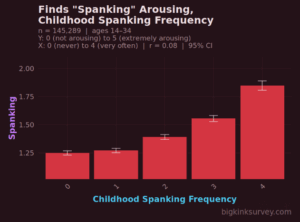
This looks fascinating but I am not at all sure how to interpret the figures given with the chart, apart from their depiction of what appears to be a positive correlation between those who experienced spanking in childhood and those who later find it sexually arousing. I would be very wary indeed about reading too much into this without further information on the work.
Note a further comment by Mike Bailey recorded in Aella’s Wikipedia entry. He has criticized her “casualness” but praised her willingness to brook controversy and said her work was worthwhile.
As I say, it looks worth exploring… with care. So, intrepid explorers, over to you!
Here’s a video on why children don’t go outside anymore
https://m.youtube.com/watch?v=9CcBF82JFv0&pp=ygUed2h5IGNoaWxkcmVuIGRvbid0IGdvIG91dHNpZGUg
Great article
Glad you think so, Swoll, and thanks for taking a moment to say so.
Your welcome
Additionally, you say:
“giving rise to unhinged cries about how that most warped people have a cannibalistic urge to sacrifice the innocent. The blood libel reborn.”
==
Well, in light of the record of the c.i.a., etc. (including, no doubt, european nations, each..or is it REALLY only the e.u. now?), i have to wonder. Outrageous, yes, to the average strategically-challenged, but if you’ve pursued whistleblowers demystifying these groups like i have….it really wouldn’t be a surprise.
Tho done without the lurid details as articulated in the usually emotive media.
But for the grain of truth that we DO live in an empire (or, i do, anyway; i understand the u.k. is really facing hard times now after brexit), and that there ARE people who are trained to do some really heinous shit. Just reading over John Stockwell’s sharings over at http://www.thirdworldtraveler.com can bring that home. (Note that the c.i.a. apparently considers Stockwell a ‘patriot’ since he didn’t do what Philip Agee did, etc.)
Or to recall the program of israeli torture of young kids, even.
This is the ugly kind of world we live in, insulated as we’ve been in various ways (i figure y’all in the u.k. aren’t nearly as insulated as we n.americans, at least on matters of foreign affairs?). So it wouldn’t surprise me in the least if some c.i.a. agent and/or combat vets come back ‘home’ and have such things going. And maybe the Epstein thing is meant to unveil THAT at some point?? Once their handlers are out of the way??
Oh, and i saw the longish interview that the hated (by the organized Left) reporter (i forget his name) did with Epstein. And that humanized him for me, some. Which is a good thing. And yet…. and yet! Yet i KNOW the pattern of LIES and DISINFORMATION in n.america! So THUS it COULD VERY WELL BE JUST AS YOU SAY IT IS.
So i’m “on the fence” on this one, man. i respect your stand, but i felt compelled to speak up on the nuances as i see them. Regardless of whether you choose to publish them on your page, or email me! Or not! (i say, SAD, SO SAD, on your part, if not!)
i read over your thoughts and links a good ways, and your argument that these women are merely seeking big $, but i feel like i need to “take you to task” on that one.
i watched some of the videos of women speaking their feelings before ever having read your write-up on this. i can imagine that SOME of them are up to what you say. But ALL of them? And, i do find myself concerned that you would CATEGORICALLY denounce all of these women accusers, based on that assumption alone. Do you have proof on all of the accusers? Were all of these people adults when they were allegedly abused? Are you attracted to girls at all?
Because if you’re a BL like me, i can imagine why you might be a bit sexist on this one.
But perhaps i’m missing some stuff that is crucial. And perhaps i missed something in my skimming, and not reading the other comments?
i’m willing to see from you and others’ point of view, but i also know that elites can be pretty alienated people that get very very cynical and have a long-known habit of treating “the stupid masses” (as some of them say) with disdain to the point of all these wars we keep “having to” fight. Etc. And them possibly getting ready to “cull” the larger percentage of us.
But i’ve steeped myself in the finer intrigues of elite psychology, so i may be a bit less than objective, here. (As well, i was victim of an elite fellow “BL” whom has since exhibited similar arrogance, but have chosen not to openly name him…yet. Fearing his wrath, and how he has already shown his true cynicalized colors. Nor do i like the idea of outing a ‘colleague’ to the violent reaction of the State; thus, i’d RATHER see my fellow TRUE BLs step up to change his behavior!!)(Tom, if you do feel like snipping this, i’m okay with that, as i’ve spoken of it elsewhere)(tho am looking for input!)
Thought i’d at least try posting this to see if you really do want comments! (Needing a bit of engagement tonite after accidentally watching some videos of antis attacking alleged MAPs.)(Tho i bet you’d LOVE my post on Treehouse!! (a pep share there!!)
>Thought i’d at least try posting this to see if you really do want comments!
Yes, Chuck, I do. Your comment is a very thoughtful and good one. I aim to answer it thoroughly ASAP but first I must read (and almost certainly approve) your eight other comments kindly sent today, plus deal with some very urgent personal stuff.
Pedohunter on trial
https://www.facebook.com/7NEWSMelbourne/videos/paedophile-hunter-arrested/10156148623234301/?locale=ms_MY
No CSA—Anxious Loneliness Correlation
And the CSA—depressed loneliness correlation is mediated by social support.
https://bpspsychub.onlinelibrary.wiley.com/doi/10.1111/papt.70066
Children watch porn
https://onlinelibrary.wiley.com/doi/10.1111/chso.70039
Media & Risky Masturbation
https://doi.org/10.1002/ccr3.72360
* * *
Eugene Schwartz:
“At about the age of five, Zhenya experienced his first heart affection, which gradually turned into a real love. The meeting took out in the field, between the city garden and the hospital. After crossing the gate with the steps, Zhenya and her mother walked a little to the right and sat down in the grass, on the lawn. Not far away, near the baby stroller, they saw a skinny lady in black with a crying face. A girl was sitting in a stroller for about two years, and her four-year-old sister was picking flowers nearby of such beauty that Zhenya noticed her even before his mother, sadly and thoughtfully shaking her head, said: “Just think what a beauty!” “Her curly hair shone like a halo, her eyes, big, gray-blue, looked strictly – that’s how I saw for the first time Milochka Krachkovskaya[10], who played such an exorbitant role in my life,” Evgeny Lvovich recalled.
“Maria Fedorovna met a sad lady. Listening to the conversation of the elders, Zhenya found out that the girl in the stroller’s name is Gonya, that she has child paralysis, that Varvara Mikhailovna – that was the name of the sad lady – has two more boys, Vasya and Tusya, and her husband was a teacher at a real school and recently died. After listening to the elders, Zhenya went with Milochka, silent but benevolent, to pick flowers. He didn’t know how to fall in love yet, but he immediately remembered Milochka. And when the time came, he loved her with all the strength of his heart.”
https://www.rulit.me/books/evgenij-shvarc-read-998057-11.html
* * *
«Victms» Don’t Want Therapy
«many young people who have been asked their views about therapy have not described it as helpful
⋮
«participation in such research may be re-traumatizing and distressing for children
⋮
«engagement: ambivalence to trust, is reflected in reluctance to attend therapy, and learning to trust, when young people have little knowledge of what to expect, how it will help, and have experienced something that they often do not wish to talk about.
⋮
«they did not want to talk about what happened and feared that they would be pressurized into doing so
⋮
«For some, this initial feeling of not needing therapy changed as they became more distressed and realized they needed help. The ambivalence experienced by some young people is illustrated by one participant in wanting and not wanting to come,
I didn’t want to come here . . . there were times when I just didn’t want to talk about anything.
⋮
«young people who spoke of previous experiences with child protection and law enforcement professionals where they felt their trust had been broken.
⋮
«Some dropped out of the therapy at this point and referred to not feeling heard when they expressed their desire not to speak about the trauma,
It was the fact that I had to drag up the things that had happened and that I didn’t have time to think about it and that I felt pressured to talk about it when I didn’t feel ready. . . . And when I said “no” many times and that I couldn’t do it, she didn’t listen to me so at the end I had to say it to her. That was difficult for me. (Girl [17], Dittman & Jensen, 2017, p. 1226).
⋮
«feeling guilty about the abuse or the impact on their family.
⋮
«For those who have experienced sexual abuse, past experience of having been silenced and silencing themselves, compounded by self-blame, guilt, and shame (McElvaney, 2015; McElvaney et al., 2021), are likely to be contributing factors to the reluctance to speak to a stranger about these intimate and embarrassing experiences. Potential ways of motivating young people to engage in therapy can be found in what young people said about what they found helpful in their therapy, such as providing explanations as to how therapy works and sharing information about sexual abuse and its impact.
⋮
«while it was painful and challenging, it was important to speak about their experience of abuse and allow themselves to experience painful feelings.
⋮
«young people also emphasized the importance of not feeling pressurized to talk about the details; for some, this resulted in them terminating the therapy.
⋮
«challenging them to move outside of their comfort zone»
https://doi.org/10.1177/15248380261437090
theres been a plethora of stories about teacher student relationships on facebook. ive been brave commenting on some of the negative posts (i dont read most of the replies as i dont like being called names). any non uk people on here might not be aware that two 10 year olds killed a 2 year old in 1993. now people deem these people to have been quite capable at age 10 and want them executed so why do they deem older kids incapable? one of the great mysteries of our time.
In reply to the 10 yr olds you mention: They do this same thing by “trying kids as adults” in the u.s.a. for certain crimes. So it’s similar. i don’t know why more people don’t point this out? (And since i’m on the topic, basically, why don’t more people point out the strategic use of misleading legal jargon? i know of one author known to have written a book about it, but only one!)
Only morons can be against paedophilia
https://www.tandfonline.com/doi/full/10.2147/JMDH.S578569#d1e1372
Paedohunters attack а сор
https://greekcitytimes.com/2026/04/21/self-styled-paedophile-hunters-attack-police-officer-in-ambush/
«Grooming Scale»
https://doi.org/10.1177/08862605261428180
Sex with a «romantic partner» is disclosed earlier then other CSA
https://journals.sagepub.com/doi/abs/10.1177/19253621261441351
Promiscuous raped more
https://www.tandfonline.com/doi/full/10.1080/01488376.2026.2648273
Abuse doesn’t predict trauma
https://doi.org/10.1177/07067437261442418
Killed in prison
https://www.mk.ru/incident/2025/04/09/stali-izvestno-kak-proizoshlo-smertelnoe-izbienie-pedofila-v-kolonii.html
No CSA—Adult Social Functioning correlation
https://doi.org/10.1177/15248380261439146
«Sexual Justice»
https://doi.org/10.1080/19317611.2026.2655809
Media dependence overgrown
https://doi.org/10.1177/10598405261442685
«Victims» not to be pervѕ
https://www.psychologytoday.com/au/blog/sex-esteem/202604/how-can-survivors-regain-pleasure-after-sexual-trauma
STDs in CSA just 7%
https://www.sciencedirect.com/science/article/abs/pii/S1341321X2600067X
12-year-old raped а 60+-year-old.
Believing that kids can be initiators is called cognitive distortion.
https://www.mirror.co.uk/news/uk-news/boy-12-assault-woman-birmingham-37047502.amp
Victims do not grow up as drug addicts (only alcoholics)
https://www.mdpi.com/1648-9144/62/4/772
«child sex abuse cases carry substantially longer periods of wrongful incarceration than drug or theft cases»
https://digitalshowcase.lynchburg.edu/studentshowcase/2026/oral_presentations/18/
Dismember a registry MAP
https://www.usmagazine.com/crime-news/news/teen-told-girlfriend-he-killed-pedophile-and-cut-him-up/
Beat a drinking comrade
https://tumentoday.ru/2026/03/03/sud_vynes_prigovor_ishimtsu_zashchitivshemu_rebenka_ot_nasilnika/
[MOD: Cyril, I have to check all these links, which takes time. Please restrict the number you send. I have deleted a few here.]
I won’t limit the links, just delete them. It is enough for me that you see them.
La Stock must surely be counted among the “antis”, but i’m sure Tom will find the 10th graf in this her latest for Unherd – the one beginning “Since the sex you have with others…” a remarkably “ironic” convergence on what i’ll call the central focus of TO’C’s big Sex & Culture paper – the matter of sexual exceptionalism? Too good a chance to pass up here to mix it up with the Unherderati? To complicate, even confound their discourse very nicely somehow ?
https://unherd.com/2026/04/spare-me-labours-summer-of-sex/
>Too good a chance to pass up here to mix it up
You reckon? Too late in the day, for one thing. UnHerd readers move on quickly. For another, it’s not enough to point out the UH piece was a “Stock response” in every sense to a campaign of self-parodying banality. Beyond that, an effort “to complicate, even confound their discourse” would more than likely end up just complicating and confounding one’s own day!
Still, nice see somebody paying attention to my critique of sexual exceptionalism. Thanks for that, Mr Turp!
Aside from the accurate observation that Unherd readers move on quickly – we’re all almost forced to do so by now by the frenetic abundance of offerings presented to us daily- I do not really “get” your response here, Tom! Can you not see that what I was after is this part?
“Since the sex you have with others is a product of the wider relationship you have with them, a sex education worth its name would require making substantive moral judgements about good and bad relationships”
Judging good and bad relationships and the reality of wildly varying abilities to do so. This is not sexual exceptionalism. This is recognizing that sexual situations too must form part and parcel of the whole moral picture. Stock seems to be saying such recognizance should be part of anything worthy of the term “sexual education” Isn’t Tom’s paper saying much the same thing? Minus perhaps the institutional apparatus?
)this gets truly tricky and daunting however when one recalls Tom’s reaction to eugyppius’s scorn at those in a certain German state proposing to “educate” kids in the pursuit of Selbstbefriedigung! (
Sorry, Turp, I don’t see anyone coming up with a one-line zinger or short, sharp paragraph as an effective UnHerd comment based on what you say. It all sounds a bit woolly, TBH. If it was that easy, wouldn’t you simply have posted your own comment?
Oh dear god, and now the most consistently refreshing/abundantly travelled writer in England – I speak of Ed West – has fallen for the insta-stupefying sound of that nonsensical trope “”convicted pædophile” Unfortunately my subscription budget doesn’t yet include Ed’s stack so I cannot reproach him. Do you know of the German context here, Tom? I’m guessing you would…
https://www.edwest.co.uk/p/our-trojan-war-and-paradise-lost?utm_source=post-email-title&publication_id=300322&post_id=194680744&utm_campaign=email-post-title&isFreemail=true&r=3pkhw&triedRedirect=true&utm_medium=email
It’s unfortunate that West’s article is partially pay-walled. I found the accessible first part interesting, not least because I have read the book on which it is focused, Alec Ryrie’s The Age of Hitler, published last year.
Ryrie makes a strong case that in the post-war years the focus on Hitler as the embodiment of evil has been a sort of secular religion that he filled the gap left by the decline of Christianity’s appeal and authority. That cannot last for ever, as Nazism fades into the less immediate past, so we now have culture wars battling for new expressions of our values.
You asked if I know about “the German context”. Presumably you mean not Nazism as such, but the “notorious case in 1970s Germany when authorities placed children in the care of convicted paedophiles, partly motivated by the guiding sense that the Nazis would have opposed the scheme”.
The case West had in mind was almost certainly that of the so-called Kentler Experiment. Initiated in the late 1960s by German psychologist and sexologist Helmut Kentler, the scheme involved the placement of homeless and neglected children into the care of paedophiles in West Berlin. The experiment continued for roughly 30 years, ending only in the early 2000s, and was actively supported and funded by the Berlin Senate and local youth welfare offices.
Kentler believed that paedophilic men would make especially loving and dedicated foster parents. His ideology was rooted in the idea that sexual liberation was necessary to prevent a return to authoritarianism. As West noted, Kentler argued that the Nazis, who emphasized sexual repression and rigid family structures, would have opposed such a scheme, making its implementation a form of “antifascist” progress.
Kentler has been discussed quite extensively in the Comment space at HTOC over the years. I also blogged about a similar project, or “experiment” in the Netherlands back in 2015: https://heretictoc.com/2015/02/09/damn-fine-judges-in-amsterdam/
Not only Kentler, there were other scholars who supported paedophilia during the sexual revolution, such as Guy Hocquenghem, Michael Foucault, Fritz Bernard. What is interesting, AI Claude has just refused to provide this information when I replied about the purpose of my requests.
>AI Claude has just refused to provide this information when I replied about the purpose of my requests.
Interesting, and sinister. What exactly did you say about “the purpose of my requests”? Did you mention Heretic TOC? If you did, that’s fine, of course. This site operates in compliance with UK law. I wonder whether Claude in Europe is trying to stay compliant with EU regulations, which have been getting tighter.
https://claude.ai/share/0cc78598-b7eb-4bb2-80ba-f1cdf8094fbe
In response to Cyril’s questions about other scholars apart from Kentler who “supported paedophilia during the sexual revolution”, Anthropic’s much-vaunted AI called Claude gave some very weak answers: poorly researched, downright inaccurate, and hopelessly biased in a politically acceptable way.
Worst of all, after being pressed by Cyril for more information, it began to question his motives for asking his questions, and then refused to cooperate entirely when Cyril declared his support for the scholars Claude had been trashing.
Without naming the subject under discussion, I mentioned to Google AI that Claude had been “censorious” when answering a question put to it in Russian.
Google AI said:
I then said that although the question had been asked in Russian, it had probably been sent from an EU country. Google AI added:
Tight EU regulation was something I had already mentioned at HTOC, so Google AI agrees with me on this.
I found the study that this archived news piece was quoting:
Joan D. Atwood. (2006). Mommy’s Little Angel, Daddy’s Little Girl: Do You Know What Your Pre-Teens Are Doing? The American Journal of Family Therapy, 34(5), 447–467. https://doi.org/10.1080/01926180600812340
She has also published: When Love Hurts: Preadolescent Girls’ Reports of Incest. The American Journal of Family Therapy, 35(4), 287–313. https://doi.org/10.1080/01926180701389644
In 1987, she wrote with John Gagnon – “Masturbatory Behavior in College Youth.” https://doi.org/10.1080/01614576.1987.11074907
This and her use of social construction as a framework, suggests to me that she might be worthwhile reading…
same 13% of relapse
No need for lifetime term
https://journals.sagepub.com/doi/full/10.1177/00111287261434527
Age, not maturity predicts sentence
https://doi.org/10.1002/acp.70195
«Only emotional abuse and emotional neglect showed significant total effects.»
https://doi.org/10.1177/00332941261441834
«Victims of female perpetrators were significantly more often male.»
Just as Susan Brownmiller claims incest to be patriarchic rearing—but if incest is mother-son, it must be matriarchic one.
https://doi.org/10.1080/10538712.2019.1685616
Do you guys have any books you can recommend me on the pathologization of pedophillia? Im trying to read some books on big pharma and the medicilization of normal human traits/sexuality, but the best ive found is a brief paragraph about how hebephillia shouldnt be considered a mental disorder(and it was very sex negative at that, which gave the whole book a negative tinge for me)
Big subject, but we have to go back more than a century, to when Big Pharma was not all that big, for the beginnings of the pathologizing, when Richard von Krafft-Ebing gave us the term “paedophilia erotica”. I blogged about him briefly back in 2016. See link and first para below.
https://heretictoc.com/2016/09/08/the-seven-ages-of-sexual-attractiveness/
Most relevant would be scholars arguing over whether pedophilia should constitute a mental illness, and the most overt debate on that in English was initiated by Richard Green, who argued for pedophilia’s de-pathologization using the same criteria he had once used when writing about adult-adult homosexuality in the 1970s.
See, Green, R. (2002). “Is pedophilia a mental disorder?,” Archives of Sexual Behavior, 31(6), 467-471.
Alongside many others, he also joined in a later debate, arguing that the then proposal to make hebephilia a mental disorder was absurd. Green, R. (2010). “Sexual preference for 14-year-olds as a mental disorder: you can’t be serious!! (letter to the editor)”. Archives of Sexual Behavior. 39 (3): 585–586. Full letter on Ipce.
You will find links and discussion of the many responses to Green’s 2002 paper, in Peer Commentaries on Green (2002) and Schmidt (2002). [Original journal link here]. I particularly recommend Paul Okami, Bruce Rind, and Vern Bullough’s responses.
If you really want to get into early psychiatry and pedophilia, Steven Angelides may be helpful. See, e.g. Historicizing Affect, Psychoanalyzing History: Pedophilia and the Discourse of Child Sexuality.
You can find relevant quotes here https://wiki.yesmap.net/wiki/Research:_Psychopathy_and_abnormal_psychology , here https://wiki.yesmap.net/wiki/Research:_Pedophilia_as_a_sexual/erotic_orientation , and here https://wiki.yesmap.net/wiki/Research:_Nonsexual_aspects .
For books, Michel Foucault was famously critical of psychiatry. See his Newgon page here for his comments on pedophilia and age-gap sex.
Thomas Szaz’s “Myth of Mental Illness” is a classic of anti-psychiatry…
Now that’s what I call an answer! 🙂
Below, you’ll find a link to the short film thanks to which Amos Yee won a competition in Singapore when he was 13 years old, beating several other more professional adult competitors. Not only intelligent, but also cute!
https://drive.google.com/file/d/1Zry8mPz60hSwI7B0nYa3HNGQendWmkcm/view
The entire story around the film can be seen here:
https://www.amosyee.org/jan.html
https://www.theguardian.com/sport/2025/dec/05/three-year-old-chess-prodigy-youngest-official-rating-sarwagya-singh-kushwaha
Talented, obviously. But if kids can have too much screen time, how about too much board time? He is said to play five hours a day.
His parents (slavedrivers?) want him to be a grandmaster.
i’d say it all depends on the privilege/class of those people as well as their culture. And what if the dude WANTS and LOVES such? i figure there are other possibilities, of course!
OK, Chuck, now I’ve finally got a moment let’s see if I can answer your questions.
Firstly, no, I have not considered all the complainants’ cases in detail. Epstein is constantly all over the media and everyone seems to be on the hunt for anything that will discredit him. I read a lot of this and hear a lot on broadcasts. But what I hear is mostly tedious repetition of how terrible the guy was but with no credible supporting detail. In an earlier blog piece of mine, I gave reasons for thinking Epstein was actually quite a nice guy. At the end of it I said, “I have no idea where this ‘monster’ thing is coming from. Am I missing something?” Nobody responded to that with anything factual that would support the “monster” view.
Can you fill that gap, Chuck? You refer to videos of women telling their stories. I invite you to give me a link to just one of them, the one that tells the most compelling victim story and which gives (in your view at least) some credible detail. I am always open to changing my mind if, as I say, I have missed something. Until that happens, though, I’m sticking with the principle “innocent until proved guilty”. Yes, Epstein was convicted of one offence, but I refer you to what Tom Hubbard said about that, in my blog. That so-called offence doesn’t really amount to a row of beans.
You say, ” Are you attracted to girls at all? Because if you’re a BL like me, i can imagine why you might be a bit sexist on this one.”
I am both BL and GL. On the basis of the point you have just made, my assessment should be very even-handed and objective! 🙂
That said, you are right to be no friend of elite privilege.
Appreciating your method of response!
One link:
https://www.youtube.com/watch?v=2EDTLi-G8Ck
From a woman, un-named and anonymized (which certainly messes with those who think all the “survivors” were in it for the $$$) in this somewhat short BBC interview, who was 19 at the time. And whose treatment, i felt, is illustrative of a very materially ‘rich’ man’s normal insensitivity and aloofness.
Note i did watch the entire interview that Bannon did with Epstein, and now see why the media systematically suppressed his voice; since he did not “sound like” a monster or anything close. Except for his eccentricities, such as changing his clothing mid-way thru the interview (an artistic-intuitive self-defense measure, i figure, as he went from a white shirt to a black one).
I was also moved by Virginia Giuffre whom SEEMED like the kinds of things detractors say about her, at first (i.e. her lying to a local “recruiter” woman at her trailer park that she was 18 when she was in fact 14, so that she could make some badly needed $$)(I suppose Epstein could have only avoid that by asking for ID first?);but then inexplicably killed herself. Why would she do that if she was a fraud??
I do know that at least one book was published about her life that she did not authorize and was angry about. And can easily speculate the “feeding frenzy” may also have drove her to such a place.
At least one of the books Giuffre didn’t like (i found out while listening to her speak after i read it) was:
“Virginia Roberts Giuffre: A Memoir of Survival: Nobody’s Girl – The Shocking Story of Virginia Giuffre Escape from Exploitation and Her Pursuit of Justice” by Ava J. Sinclair
My notes say about this book:
Reads like a book of total opportunism! No citations backing claims! Very superficial in content! Misleading about how much Giuffre is behind this! And: Misleading in the ‘disclaimer’ section saying Giuffre is “the author”!
Plus, it read like an effort to push “the untrained eye” (page 25) Back into an observer-only place (as opposed to a democratic approach) in a notable effort by the actual author (as i read further) to push the ‘Conservative’ ‘Rolback’ agenda. Nor does the book demystify elite norms (i.e. of the meta in the social, where socializing “freely” does tend to entrap unwary people).
Scapegoating Epstein for the normally-aloof elite narrative of meta-manipulation generally, was my impression.
So have to wonder if books like this, including the usual systematic propaganda “feeding frenzy” that accompanies these media hysterias, drove her to suicide? Anyone have another credible idea?
Sorry if this all comes off as a bit rough, i’m not refining it, just putting down what jumped out at me. I could share the details of my notes of the book but figure i don’t need to, as i think i touched on the main insights.
I do see Epstein as scapegoat-able in elite circles, due to the fact that he wasn’t “Old Money”. And, yes, i was initially seeing the possibility that he was hooked up with mossad and israeli interests, but haven’t seen anything proving that.
Thanks, Chuck. It may take me a while to come to a view of what you say here and in your other posts today (just read this one; about to look at the others).
Perhaps you can add this to my initial response?
I may have gotten Jena Jones’ view mixed up with Giuffre:
https://www.youtube.com/watch?v=oaaF_Yy6NY4
It’s one our and about 22 minutes of Jena Lisa Jones’ experience.
i think of this as very honest-oriented, and allows for some context to the psychology of the young woman from a very different class background (age 14, and lied about it to get the “big” $200).
i say all of this in the context of my being very aware of how the media lies and takes things out of context, etc. I.e. i’ve read “The Man They Called A Monster”.
lots on facebook about a 25 year old teacher giving students sex education… yes, only 25 and is being called all kinds of names. lots of people saying lucky kids some saying child abuse (horse shit) of course if the genders swapped around it would be different kettle of fish damn hypocrites…
«decrease in cognitive distortions»
https://doi.org/10.1080/10538712.2026.2658664
Brother-brother sex isn’t love
https://doi.org/10.1080/13552600.2026.2646599
«CSA allegations occur less frequently than allegations of other maltreatment types.»
https://doi.org/10.1177/15248380261429518
Conspiracy is difficult, but possible
https://www.proquest.com/openview/ffc01e6fe1db810167d7f85e35400ee4/1?pq-origsite=gscholar&cbl=18750&diss=y
Counter-productive anti-sexual education
«Magdalena Hulth, in ‘It can be an abuse, even though both have consented: Swedish preschool practitioners’ discussions abour teaching (sexual) consent to preschoolers, explores how educators construct consent education for preschoolers, determining what children should learn about consent and how it is taught in Sweden. While hugging is considered an appropriate practice for learning consent, teachers prohibit actions they associate with sexuality to protect children from behaviours considered off time for their age. However, in aiming to protect children from sexual abuse, this consent pedagogy sexualises them and fails to provide meaningful opportunities to learn about con-sent. The author argues for incorporating the complexity and ambivalence of consent—rather than an absolute clarity—into education, starting from children’s experiences and positions rather than adults’ beliefs and fears about sexuality.»
https://onlinelibrary.wiley.com/doi/epdf/10.1111/chso.13003
«When the perpetrators were women, the participants described lower psychological impacts.»
https://doi.org/10.1080/20008066.2026.2650092
No CSA—Eating disorders correlation
https://doi.org/10.53680/vertex.v37i171.975
«sexual abuse, gender, and age at first trauma did not significantly predict PTSD symptom frequency.»
https://doi.org/10.1080/19315864.2026.2655129
«childhood internet use has been associated with improvements in academic achievement, learning development and digital literacy»
https://doi.org/10.1016/j.jaacop.2026.04.001
The UK’s Crime and Policing Bill is set to make the viewing of ‘looks young’ adult porn a child sex offense – https://www.brianribbon.com/home/how-the-uk-will-implement-cso-registration-for-adult-porn
The next one will be that bicycle theft is made a child sex offence.
FROM WHAT I remember australia has a similar policy in place already…
Moral panic is an inexhaustible source that will not quench their thirst. The fight against the “Boogeyman” will always expand the scope, because the fears will not disappear as long as a person continues to listen to the rustling in the basement and feed these fears, afraid to go down and research the reason.
Suffocating “protection” will lead to resistance and a struggle for liberation.
Great if horrifying article overall Brian. I didn’t quite understand this passage, though:
“What makes this particularly insidious is that upon conviction, a person who has merely viewed such a video on a site like Pornhub will become guilty of a child pornography offense. More specifically, one of making child pornography due to how viewing – or making a copy on a screen – is classified under UK law.”
>It’s the bit in bold I’m confused about. Do you mean taking a screenshot of a page? Under UK law as I understand it, to download something is to make a copy, and therefore to have “made” unlawful pornography.
This can lead to muddy waters and hugely misleading phrasing, where someone convicted of “making child porn / indecent images” had in fact merely saved some cartoons featuring flat chested women of indeterminate age, rather than being sat filming with a camera whilst a kid was raped in front of them…
Do you literally mean that viewing a webpage will be classified as “making” something in future legal codes?
You “make” images automatically when they appear on your screen, as they are stored in your browser cache. You are legally responsible for what is in the cache even though you didn’t actively put it there.
Thanks for enlightening us. Totally ridiculous logic from the UK gov there. At least with the whole “download = making a copy,” that at least makes some sense. The browser cache thing is so, so abstract. And I’m 99% sure the most people couldn’t reproduce an image / video based on browser cache data. Just so, so ridiculous…
A friendly reminder that if you’re an especially cautious person, browser cache data can be erased / deleted. Software like BleachBit can help.
What happened is that Judge A decided a possession conviction required knowledge of possession or at least the know-how to retrieve the file. Judge B, who presided over a later case, was an asshole and didn’t like that; he decided in his great wisdom that people who could be proven to have at some point ‘made’ a copy on their screen had made indecent images.
The crime of making indecent images was only ever intended to be used against people printing copies for physical distribution, but that asshole judge created new case law that was never anticipated and never challenged, because the UK is a draconian hellscape that would feed a child to lions if it could also feed a MAP.
Im kind of confused how the natural human form god created is to so called Christians. ‘indecent’ bit insulting to their god,no?
Interesting discussion! i was “on the fence” about Epstein, leaning towards him being a typical elite person who is totally aloof to the difficulties of being from trailer ‘hoods and such realities. Thinking of him being like other elites i’ve known, nice enough at first, only to ensnare one into some kind of not-adequately-dealt-with pain from their elite upbringing. At least the tresspass against me was out in the open.
So, i thank you for helping me see the nuance of it.
On the Horrors of hamas vs israeli terror:
Have you all not seen the documentary put out by Al Jazeera?
https://www.ajiunit.com/investigation/october-7/
Very very interesting, i thought. This seems to be an updated version of the docu i saw some months ago.
Hello! I have been researching the topic of ACSC for quite a bit and i would love if the wiki could respond to these two articles (https://www.sciencedirect.com/science/article/abs/pii/S0145213402003174 and https://pubmed.ncbi.nlm.nih.gov/12151287/#:~:text=Men%20who%20reported%20sexual%20molestation,range%3D1.3-5.2)., available on Annas Archive).
They have been shown to me as counter-arguments against Bruce Rind, claiming to show that, even if adult child sexual contact is viewed positively, this still leads to increased negative mental health problems. Unsure what to make of it, if its caused by secondary victimization or not.If an article is ever written, or if a rebuttal is added to the wiki, please email me. Thanks a lot!
Quick unresearched response.
1) First link is to Kelly et al. on mother-son incest. Rare paper on this topic, so interesting on that account. But all clinical studies, such as this one, should be treated with caution because, by definition, they focus on people with problems. So they say nothing about the experiences of those guys who have experienced mother-son incest but do NOT have mental health issues and have NOT ended up receiving clinical attention.
2) Second link is to a paper by King, Coxell and Mezey. Two of these authors King and Coxell, had done an earlier paper reporting far more positive results, which Bruce Rind referred to in one of his papers. If I remember rightly, this created a big backlash against these authors, who quickly moved to put out another paper that would “correct” their first one. But they never repudiated their own initial data, nor did they claim Rind had misinterpreted it, though they might have claimed the wider media had done so.
I doubt whether this second paper really “corrects” anything. Much depends on the definitions used (of “molestation” etc). As I say, though, this is just a top of the head quick reaction. I may be wildly wrong but I doubt it.
Probably the key thing is the era to which the data relate. In the original Coxell & King paper, broadly speaking men reported a lack of ill effects when they said the childhood so-called abuse had been consensual. The later paper, by contrast, reports more self-harm by men with childhood consensual experiences.
If memory serves, the data from the first paper came from men who grew up mainly in about the 1930s or 1940s. Nobody told they they had been abused, or victimised, so those experiences never led to any trauma.
My guess is that the data for the later paper (with Mezey) were from guys who grew up much later, in the wake of the huge panic and preoccupation with CSA. So we would be looking at the secondary effects (of the panic), not at anything intrinsic to the initial sexual contact itself.
Interesting questions posed by someone at the LRB Blog: why do politicians face opprobrium for abusing young girls but not for murdering and maiming them?
https://www.lrb.co.uk/blog/2026/april/gamer-s-dilemma?ref=thebrowser.com
There’s a very powerful argument here about the politics of distraction, with the exceedingly plausible claim that Trump started the Iran war to distract from the Epstein files.
However, the writer is no fan of either paedophilia or Epstein. In fairness, he make some strong-looking points against the latter, albeit grounded in politics rather than sex.
The problem with the Epstein files is that it has become so warped and political that it’s impossible to know the truth.
I knew a girl who was invited to a yacht for a free vacation with rich and powerful business men. The suggestion was obvious, a free vacation with the rich and powerful, a party week, lost of sex and Champaign. She said no because she wasn’t single, and has sort of regretted it ever since. They didn’t use paid sex workers because the men on that yacht don’t like professionals.
This kind of thing happens, whether on yachts or islands. whether paid sex workers or women just looking for a wild experience.
So here is a very wealthy man doing the same thing, it sounds like it’s mostly women from 18 to early 20s because younger women are just more popular and it sounds like some sneaked through even younger than that. I’d be surprised if all these women were being deceived and stolen away against their wills onto a prison island, more likely they were well paid and partying. Then years later after he’s dead, it’s an opportunity for an extra payout.
I don’t know of course, maybe he was a monster but I’d be surprised if he was the villain we’re told he is. It’s now so political and he’s not around to defend himself that we’ll never really know.
https://en.wikipedia.org/wiki/Orenburg_twerking_scandal
Sataniс accusations
https://journals.sagepub.com/doi/10.1177/14614448251336431
Doll/CP means no IRL
https://www.tandfonline.com/doi/full/10.1080/10538712.2026.2656788#abstract
Alert against child sexuality
> research from the United States, the United Kingdom and Australia estimates that between 25% and 60% of all child sexual abuse is enacted by other children (Campbell et al., 2020; El-Murr, 2017; Gewirtz-Meydan & Finkelhor, Citation, 2020).
https://www.tandfonline.com/doi/full/10.1080/10538712.2026.2656794
https://www.tandfonline.com/doi/full/10.1080/13552600.2026.2652996#d1e1382
Anti-sexual education creates rapists
https://www.tandfonline.com/doi/full/10.1080/19419899.2026.2655668
Emotional abuse worsе for personality than CSA
https://link.springer.com/article/10.1007/s11126-026-10279-2
“Financially Coerced”
https://onlinelibrary.wiley.com/doi/10.1111/cfs.70193
Regarding the “Financially Coerced” item, just going by the Abstract this paper seems highly ideological.
We see a strong ideological assertion early on:
“A harmful dominant narrative has historically blamed victims by framing this form of child sexual exploitation as ‘children engaging in sex work’…”
This clearly establishes the “correct” view, then further on we have this:
“professionals ‘slipped’ back to a victim-blaming narrative at times and also ‘lurched forward’ towards narratives that held other entities to account, such as Big Tech”.
So any professionals who disagree with the “correct” view must be pulled back into line through various means, an objective made clear as the Abstract continues.
Thousands of papers are being brought out. Impossible to keep up with them all. This one is at least Open Access.
I believe strongly in youth rights ( of course) im getting very offended by signs on shops saying no children allowed without adults ( shows pic of person with small child. Must be very insulting to 17 year olds) . Same in pub. No children at bar! How they can be prepared for life at 18 i dont know. Anyway these places don’t get my custom!
Risk factors of pedo-Satanic sentencing
https://dc.etsu.edu/boland-research-day/2026/presentations/227/
“Violence” not problem for 32%
https://www.medrxiv.org/content/10.64898/2026.04.08.26344946v1
It still seems strange that Joe Rogan can invite 86-year-old Jacques Vallée and discuss parapsychology and UFOs for 3 hours, but he can’t invite 81-year-old Tom O’Carroll to discuss issues related to youth sexuality and minor attraction. Speakers on his podcasts may talk about the existence of a secret US program involving children because they demonstrate parapsychological abilities better but no one talks about “the abuse and trauma”. For some reason, discussing the ability of minors to demonstrate sexual desires and behaviour is the “worst thing”. What’s wrong ?
I do not follow what you are trying to tell us from right after “parapsychological abilities” “But no one talks about the ‘abuse and trauma’? “How doss that follow?
Can you or somebody else redo that bit for me?
Think he means nobody talks about abuse and trauma unless its something sexual.
Some speakers claim that children are supposedly more sensitive and better suited for testing in these programs. The speakers avoid addressing issues such as where these children come from, whether they were coerced, or whether they receive any care. But the topic of natural youth sexuality is taboo in podcasts; they immediately raise issues of “abuse and trauma” . This is somewhat hypocritical. They discuss a topic that could be considered a conspiracy theory, but are afraid to discuss alternative real data on youth sexuality and harm.
>For some reason, discussing the ability of minors to demonstrate sexual desires and behaviour is the “worst thing”. What’s wrong ?
For the same tired old post-Reformation ANGLO fake Puritan-Victorian backward Biblical repression still persecuting benign Gays until the 1990s. While post-Revolution NON-Anglo France dumped the Bible and made Gaysex legal in 1791 followed by French-ruled Holland legalizing Gaysex in 1810. And post-WW2 mainland modern Europe normalized benign MAP-AAM sex with benign C.P. on public sale.
Until the same old backward fake-Puritan Anglos GROOMED and gaslit the gullible World back to Victorian repression. While Worldwide millions of modern kids body proud/guilt free in Gen Selfie-Sext from age 5 including AAMs piss on fake Puritan-Victorian .sex laws in Century 21.
Hysteria declined
https://pubmed.ncbi.nlm.nih.gov/41947550/
Misandric education is effective
https://journals.sagepub.com/doi/abs/10.3102/00346543261426583
Predicting incest
https://www.sciencedirect.com/science/article/pii/S0145213426001511
Parents on sexting
https://journals.sagepub.com/doi/10.1177/17504813261435739
No long-term trauma
https://journals.sagepub.com/doi/abs/10.1177/10497323261436964
That’s all fine Cyril. Let’s celebrate for a moment, that finally, teenagers don’t fuck:
The fertility rate has been falling since 2007, in large part because of a plunge among teenagers.
https://www.nytimes.com/2026/04/09/us/fertility-rates-decline.html
Teen kills sexy offender in florida. Saw on Facebook. All comments congratulating him. Even christians. I hope the murderer and all those fake Christians go to hell. Wait the usa is hell.. im depressed… But at least he will get some jail time
.
As usual, you choose to find morons in order to get depressed for the sake of getting depressed. Read the post by Amos Lee instead (linked below), and you’ll discover that he constantly receives support from ordinary people in real life: “Fascinating, because if you read the comments about me on the Internet, you’d think that if I walked out in public I’d be killed (Though interestingly, out of the 30 or so people who took selfies and talked with me, not one of them was female. Not even an Ah Ma. Hah!) It goes to show that the Internet is not real life, and those that are worthy of being liked, will be”.
https://www.amosyee.org/back.html
Why would i look to be depressed.. i get these stories on my fb feed and ferl compelled to look and reply to some of the psychos.. but ok ill read that. There was literally no positive/supportive comments on the fb stories.. even worse fb hides my replies as i get little back.. oh i get called the n word but i call them thick .
Re Amos Yee
The public might have been nice to him that week when he wrote what he wrote but that was just that week/month or whatever I myself am an outed MAP and some weeks they are nice and pleasant with me but other times they are a complete bastard with me and because of this I am now reduced to living on benefits/welfare for the rest of my life otherwise I could of become successful instead of having to live off the system and doing nothing for nobody like I currently do.
Amos was ironically groomed by a 14 year old. Im not ashamed at having claimed benefits most my life. People have really made my mental health bad. They complain about me not working yet they bully you into becoming unwell.. and wow the internet had made things much worse. Places like this blog are sanctuaries for me..
Don’t get me wrong I am not deliberately trying to play a victim in order to get ppl to feel sorry for me (not that they ever will anyway like me or hate me not that bothered anymore) but the point I am trying to get across is that the more ppl who are hated on and driven out of the work place for being a MAP or whatever the more society one way or another has to pay for it via the benefit system which as we all know is not good for society, which is why I have said in the past that one day the world will have to rethink the way it treats MAPs so that more of them can re enter the world of work which would be not only better for Maps but it would be better for everyone.
They complain about me not working yet they bully you into becoming unwell..
When I read reports of the growing epidemic of pedophiles being driven by technology, my reaction is to be unsurprised when the definition of online offending is constantly evolving and expanding. The growth of AI means people are using AI to create erotic fiction and images rather than targeting real children. Now depictions of incest will no doubt count as pedophilia crimes. No doubt age-play will be targeted soon, as will any literature or art depicting nudity under 18 or expressing any kind of sexual interest.
When a circle gets broader it should be expected to encompass more. That’s hardly proof that there’s an increase in the population of pedophiles or more risky behaviour or more harm to children. But it makes for good headlines and helps to fan the flames of fear.
Good points.
Like your moniker, BTW. I’m not a huge Tolkien fan, but his character Tom Bombadil is attractive not least for his indifference to that bloody ring the rest of them obsess about. Indifference to the lure of power and domination is a big plus.
Thank you. I like Tom to for the much the same reason. Tom avoids the politics of the world and just spends his days in the joyfully company of Goldberry, the River-daughter. But Tom is open and welcoming to all, we’re all part of nature.
Cyril
Re Cp, the argument that antis make is that cp should be illegal (even ai porn) is that a child might have been exploited due to the fact that we don’t know where the image has come from for an absolute certainty yet at the same time they will not take the same attitude with cannabis, I say why not after all for all when they buy the drug off their dealer and that dealer buys the drug off his dealer and so on we can never know for certain weather or not the drug was originally grown by a victim of human trafficking so does that mean as a society we should hate everyone who smokes cannabis, of course not so why treat cp collectors the same way?
Parade of anti-minor media bans:
Only UK is careful about prohibitions: Hundreds of UK teenagers to trial six-week social media curbs for major study | Social media ban | The Guardian
As the UN Convention on the rights of the child states:
Im baffled as to why you have to be over 18 to buy non alcohol beer. Or why i had to be verified for buying cutlery which the most dangerous thing was a fork. Yet 17 year olds can buy cars. 16 i believe in usa. Law makers are on glue
I agree with all you say, Tom. If I hear one more time a television news reader say the misnomer “convicted paedophile”, I swear I’ll throw something at the tele, even if it’s only a feather duster to avoid damage to the screen. I have considered emailing them to inform them that there is no such crime in law as paedophilia, so no one can be convicted of it. But they would most likely ignore me. I have never seen any mention of Epstein “molesting” anyone under the age of 12. Yet the media constantly associate him with paedophilia for what they think is shock value. The Americans have reached a point now where anyone of any age who has sexual relations with anyone of any age is described as a paedophile in the hope that everyone hearing that description will have an attack of the screaming heebeejeebees. It’s a throwback to the early days of the American colonies and the Puritans who landed in Cape Cod on the Mayflower. Definition of a Puritan: Someone who day and night lives in fear and dread that someone, somewhere, may be enjoying themselves.
It’s been a while since we heard from you, MFB, and it’s great to have you back.
>I swear I’ll throw something at the tele, even if it’s only a feather duster to avoid damage to the screen
LOL! That’s a very sensible way to get mad! 🙂
As for the American Puritan heritage, I highly recommend Ed Stourton’s new book Made in America: The dark history that led to Donald Trump. He lucidly explores several key strands of this history. Entertaining and concise.
Thanks, Tom. I’ll look out for that book, although I fear that with the time period covering 1620 to 2020, it will be a very hefty tome.
Not really. It’s only about 200 pages, with not many words per page. It’s a very light touch overview of key themes, not an exhaustive history. And Stourton is an excellent writer.
>As for the American Puritan heritage, I highly recommend Ed Stourton’s new book Made in America: The dark history that led to Donald Trump. He lucidly explores several key strands of this history. Entertaining and concise.
1520s Henry to 2020s Trump. Anglo egomanic macho psycho-sadist perverse Puritans made in post-medieval London. Edward Stourton has discussed the introduction of Protestant “heresy” into England, linking it to the 1520s when Pope Glement 11 rejected Henry VIII’s request for an annulment of his marriage to Catherine of Aragon citing her (not his) inability to produce a male heir.
>Edward Stourton has discussed the introduction of Protestant “heresy” into England
I’m sure he has. He is an expert on the Catholic faith and its history.
>I’m sure he has. He is an expert on the Catholic faith and its history.
Stourton on Sunday is worth waking up to, as were his ‘Today’ presentations until, (like victim Laurie Mayer) the BiasedBritCowards bullied Ed to give way for a promised new gig that never materialized, so that tired boy Justin Webb could return washed out from Washington. And now Anglo Asian token Amol Rajan is tired of overpaid early hours and will quit to start his own clickbait Podcast. Tho he couldn’t escape from intrepid Pup’s email informing him that Orwell went to Spain to fight Fascists not the ever popular Anglo demon Commies. Correcting Amol’s on-air schoolboy error which he didn’t even have the maturity, professionalism, or courtesy to reply to, or acknowledge. So, no loose change there. Meanwhile the BiasedBritCowards install another overpaid D.G. to protect their still unnamed femme coward overpaid editor of Paranormal; er Panorama, KAREN WIGHTMAN.
https://uk.themedialeader.com/how-a-butterfly-flapping-its-wings-led-to-a-tornado-at-the-bbc/
One day people will be convicted of looking at an under 18 in an indecent way walking down the street… Do i? I really cant guess ages. But one day i bet the technology will be there and many more thousabds will be exposed as .. p word.
Ive also theorized that in the near future psychologists will “discover” a new form of “eye contact based csa”(which technically already exists since merely viewing a picture of a kids dick telepathically abuses and traumatizes them).
So many exciting new forms of “grooming” and “csa” to be discovered. All conveniently used as an excuse by the government to lock more men in prison, pass more forms of mass government survillance, strip more human rights away from the population and violate more parts of the constitution. Bringing us even closer to an Orwellian style police state. But of course, it is no problem to our moral citizens how many lives are shortly and cruelly ended, even if those lives include the innocent children they claim to want to protect, as there is NOTHING on planet earth worse than some guy looking at or groping a preteens ass, not even literal death itself.
The term convicted sexy offender is also bad
So i changed it. Theres a big difference between rape and touching someones butt,or taking a mold consentual picture of someone. But of course society is thick as pig shit and peoples houses have been burned down because of this dangerous label that the media has helped to fuel thick societys paranoia and anger
“convicted sexy offender”
>lol, you could easily make memes using that. E.g. a person on one side captioned with “convicted sex offender” (the image could be an ex-cop or “pred hunter” with a news headline in the background, or Donald Trump if you want to make it overtly political), then “convicted sexy offender” on the other side – any statutory case you can find where the older person is conventionally attractive, maybe an ex-teacher in a bikini pic…
There is great meme / infographic potential when it comes to these topics, as Newgon / PCMA showed some years ago…
And yes, the media has played a huge role in fueling hysteria around young people and age-gap relationships. You can look at that in both positive and negative ways, but on the positive, it means more opportunities to pushback and create counter narratives.
This could be done by starting a media production company, for example, where many of the world’s problems are addressed (war, poverty / inequality), but also covering topics related to sexual politics, sex and crime, findings in sexual science, etc.
Benign C.P still LEGAL to POSSESS in many NON-Anglo nations.
But NOT banned anywhere, OBSCENE images of child victims bombed, bloodied, burned, buried, dismembered, destroyed in ANGLO-made wars and famines.
https://en.wikipedia.org/wiki/Legality_of_child_pornography
Interesting how america gives you life for thre natural.human form but cuts babies willys..
Peter Tatchell, “BEYOND EQUALITY.” Socialist Lawyer, no. 26, 1995, pp. 16–17. JSTOR.
Kier Starmer, who would later become Prime Minister of the UK, appears in the same journal issue. Kier would become notorious for implementing and defending the passage of the “Online Safety Act” (OSA), which effectively ended every adult’s right to view pornography privately, since they must now provide state-approved ID to access sexually explicit content from a UK IP address.
His article here seems so pointless, that I have no idea why he bothered (perhaps it was raining and he was bored?). But wow, what a strange world it is…
AAM on F.B. Freddie Forrest
“My secret first love! Would have run off with her as a 13yo and done whatever she wanted!”
https://www.facebook.com/photo?fbid=10164661190396162&set=gm.4252527514996283&idorvanity=2026914534224270
Some american states are having death penalty for activity under 12 for example. (Very Christian) . In comments ive seen people (psychopaths) say it should be up to 18.. even brits.. why would i want to live in a world like this??
No one wants to live in a world where a 20-year-old can face the death penalty for consensual sex with their 17-year-old girlfriend or boyfriend. I’d even wager that the vast majority of people, especially heterosexual men, would privately find it horrifying and ridiculous if such a death penalty came into force. People say these things for attention and social validation, for clicks and likes and perhaps because they are bullies of have violent / psychopathic tendencies and lack empathy…
Broadly, people say these arguably extreme things because they know they won’t face pushback…
Calling for death is quite acceptable on Facebook… Truly monsters. Death penalty for 80 year old sleeping with 17 year old? That acceptable to them ? I cannot believe that such a large part of society is murderous. And a lot of them are christians.. not very good ones..
Death penalty legislation is not about the death penalty.
https://www.narsol.org/2024/02/death-penalty-legislation-is-not-about-the-death-penalty/
The very sad thing is that this hate is not banned on FB (and X, and Reddit,…), while expressions of affection might be.
I agree Matt, I don’t understand how they could be self-proclaiming christians; they seem more like the disgrace of christianity.
Anyways, I also think that these people are probably just “situational” psychopaths/zombies and cannot be considered as representing real persons.
The irony is ive seen people commenting recently,some quite sexual comments on a girl who looks 11. I have seen no angry comments off anyone… Yet im getting shit for saying teachers with pupils is fine! A lot if them are of consent age anyway.. is pretty rife at the moment and the sentences are sad
Jmail – the Jeffrey Epstein email archive and much, much more – is wild. I don’t know whether I love or hate that a team of people took the time to make extensive websites that document Epstein’s purchase history on Amazon, uploading every released video in the Epstein papers to a YouTube account, in addition to reconstructing virtually every email Jeffrey exchanged during his lifetime.
It’s kind of incredible. On one level, a feat of human creativity and ingenuity. On another level, kind of insane.
They even have an enormous Jwiki – a copy of Wikipedia entirely devoted to Jeffrey Epstein and anyone who ever emailed him – generated by AI using info from the emails…
Check out, for example, Karyna Shuliak, a young woman who wanted to become a dentist, and whom Epstein supported financially. You can find emails of her professing her love for Epstein, saying what a great man he was…
Just checking Jmail’s homepage, I see one Cecilia Steen – a name I’d not heard before. She wrote to Jeffrey upon hearing that he was found unconscious in his cell, presumably unaware that he was dead. She wrote:
Looking her up, I see that she now works at JP Morgan, and was “allowed” to keep her job despite being such a staunch supporter of the deceased “peeeeedophile” right to the end…
I encourage others to take a look over Jmail and Jwiki sometime. It’s pretty fascinating.
Amos Yee arrested on return to Singapore after deportation from US, charged under Enlistment Act
[TLDR: He’s been arrested because, by fleeing to the United States, he hasn’t served his mandatory military service in his home country.]
https://substack.com/@norman506968/note/c-230186711?r=7y8tfs&utm_source=notes-share-action&utm_medium=web
Pre-Anglo negative grooming – forward France Sexy ’70s.
In 1974, a French writer named Gabriel Matzneff published an essay titled Under Sixteen Years Old — a manifesto arguing that sexual relationships between adults and children as young as ten were a form of liberation for young people. He was not anonymous. He was not fringe. He was celebrated. The book established him as a provocateur in the highest circles of Parisian literary life.And in the years that followed, an open letter calling for the legal decriminalization of sexual relationships between adults and children as young as ten were a form of liberation for young people — and was signed by some of the most famous names of the twentieth century: Jean-Paul Sartre. Simone de Beauvoir. Gilles Deleuze. Roland Barthes.…
https://www.facebook.com/photo/?fbid=122120742993157364&set=a.122097573525157364
Anyone take a screenshot or have a backup page for that link to FB? I noted it was now gone…
Young teen girls immediately hit with ‘explosion’ of sexually explicit messages and photos when they sign up for social media.
CUMments, “Bet you two are really tight.”
https://www.yahoo.com/news/articles/young-teen-girls-immediately-hit-202909574.html
I think it will be interesting
The Limits of Sexual Autonomy for Minors: Debating Age of Consent Laws
Yes, this is an excellent paper and it is open access.
The author has an interesting global perspective, drawing on examples from Japan, Indonesia, and the Netherlands.
Heretics here will find this paper says all the right things, at least with regard to “youth” rather than earlier childhood.
Cleves, Rachel Hope. “A Forum: Coming of Age in the Age of Coming Out; The Transformation of Queer Youth Experiences in the United States, 1953–1983.” Journal of the History of Sexuality, vol. 35 no. 1, 2026, p. 114-118. Project MUSE, https://dx.doi.org/10.1353/sex.00054.
[If you’re looking for an older woman to steal away from her husband, Rachel Hope Cleves has my vote! She’s lovely, she’s smart, and she’s not crazy; what’s not to like? :p ]…
>Cleves, Rachel Hope. “A Forum: Coming of Age in the Age of Coming Out; The Transformation of Queer Youth Experiences in the United States, 1953–1983.”
Nearly 200 years before Biblical backward Anglos, In 1791 forward France normalized Gaysex
as part of their new legal code without the influence of Christianity. French-ruled Holland normalized Gaysex in 1810. While, since 1978 humane France has protected Anglo persecuted MAP Roman Polanski And in 2017 forward France welcomed their benign MAP first lady Brigitte. .
Meanwhile inhuman, backward repressed Anglo Victorian fake Puritans with the modern World’s worst non-sex child welfare and poverty, bomb and destroy children Worldwide, and air obscenely painful images of children in war and famine free for all ages to view. While frenziedly banning Under 16s from viewing benign images of mere natural sex pleasure.
Still perversely posing as World best role-model, Anglo Victorian fake Puritans try to groom and gaslight the World with their fake media ‘CSA’ mass deception deviously masked as so called ‘Child Protection’. A child protection racket, fake virtue waving ‘New Patriotism’, last refuge of scoundrels bought by mugs and morons. Paraphrase 1874 ongoing tax-dodge charity NSPCC, “Donate now. We say you PayPal.” .
While, Worldwide beyond control, body proud, guilt-free Gen Selfie-Sext webwize from Age 5 rightly piss on Anglo Victorian fake Puritan sex laws.
Quote, typical fake media tabloid trashed groomed & gaslit Anglo dim Dad, “Er, you’re nearly 13 now, and we have to talk about,er, Sex!”
Streetwise, webwise young son, “OK Dad. What don’t you understand?”
Since then, “humane” and “forward” France has joined “Anglo Victorian fake Puritans”: sex with 14yo = rape, 5 years in overcrowded jail for PIM, compulsory age verification (by ID or picture) for porn sites (otherwise site blocked), social networks banned for under 15, etc.
>Since then, “humane” and “forward” France has joined “Anglo Victorian fake Puritans”
Re-phrased, Anglo groomed and gaslit France and the wider World have been ‘psychoerced’ and ‘psycholonialized’ into joining the Anglo fake Puritan populist MAP witchunt racket. For ratings, profit, power and control, fake media deviously masked as so called ‘Child Protection’, fake tag, “Saving kids from SEX.”.
Post-Anglo Reformation (of convenience masked as conviction) self-justifying English Puritans falsely believed (then as now) they were conducting a holy war to purify the world of sin. They saw Catholics and Muslims as idolaters who deviated from the King James Bible falsely equating Popery and Islam with heresy or witchcraft. King James V1 of Scotland/1st of England MAP (attended by Courtiers all young boys with slim legs and pert butts) authorized seven cringing scribes over five years to create the official Protestant King James Bible/KJB. Then totalitarian misused Worldwide to persecute and control millions of victims in supposedly ‘Democratic’ Anglo lands of lies. About as ‘Democratic’ as the totalitarian Soviet/KGB.
E.G. the 2016 Anglo UK undemocratic vote to leave the democratic EU, was a
mere 72% turnout meaning that 13 million morons ignorantly thinking that no-vote meant ‘Remain’ did not vote at all. Meaning that the truer vote was (as in high turnout more educated Scotland and Ulster) a 62% majority ‘Remain’. And, the 2024 latest UK vote for Labour’s so called ‘Landslide’ was the lowest on-record since 1928, a shameful 52% turnout. While their Anglo U.S. land of lies fake system gerrymanders it’s rigged College system, and buys big corporate votes, while suppressing non-White votes. Anglo deMockracy they can’t even spell it.
Post-Reformation Anglos, History’s worst genocidal racists, thieves, liars, and hypocrites still perversely posing as World best role-model – WTF?!
Quote, Sexy ’70s ‘Love Generation’ CSNY, “Teach Your Children Well”.
https://www.youtube.com/watch?v=dQOaUnSmJr8
>Since then, “humane” and “forward” France has joined “Anglo Victorian fake Puritans”: sex with 14yo = rape, 5 years in overcrowded jail for PIM,
So, French MAP First Lady Brigitte to be retro-jailed for raping 14yo victim-survivor AAM Emmanuel in 1991?
https://www.facebook.com/watch/?v=1830366237729276
consistently seema to me the “happy humping pup” is not much of a happy humping pup at all. He’s much more akin to a blindly battering ram! Up against the wall(of this monstrous edifice he calls (things like) “Anglo Victorian fake Puritans”, and he’s now gussied thiat wall up for us w/ his tale of a “Catholic/Muslim” world, supplanted by the Protestant World! .Sheeee! What delirious daily orgies of little kids did we Prods doiubtless lay to waste! I can see, Why, I can still feel the squirl and whirm of eVery little bottom present there from here !
Mister M Tracey, Protest-ant of this Æmerican parish, has enjoined us “to make insufferable people’s heads explode” Give us ONE reason Mr Ram that it’s more important to keep banging your drum.here than simply reporting in on what ‘explosive charges’ we’ve laid where and what the reaction to them has been thus far?
>Give us ONE reason Mr Ram that it’s more important to keep banging your drum.here than simply reporting in on what ‘explosive charges’ we’ve laid where and what the reaction to them has been thus far?
Quote fairplay TOC, “Play nicely now.” HappyBumpingRam gives regular reasons to be leerful to BlindWarble blissfully happy with post-Reformation Anglos. History’s proven worst genocidal racists sexist thieves liars and hypocrites, still perversely posing as World Best role-model – what the Warble?!
BlindWarble asks, “What explosive charges and the reaction to them thus far?”
Er, on-topic for child lovers then and now and so much in between on-record, it ain’t Rocket-Science. 1640s Anglos terrorized and slaughtered 1/2 million Irish Catholics including children in the own land, and since then falsely labelled Irish Catholics as ‘terrorists’? 1946 Anglos were terrorized and slaughtered by Anglo-enabled European Zionist terrorists in Jerusalem’s King David Hotel, Palestine. Launching an eight decades ongoing Nakba of Palestinians including children terrorized and slaughtered in their own land, while falsely labelled ‘terrorists’ by lying Anglos and Zionists. Paraphrase a 1950s bright young Palestinian boy forced to exist in a concentrated refugee camp in his own land, “Papa, why are we forced to,live in crowded camps by Foreigners living our old homes?”
It ain’t Rocket-Science, bright young Palestinian boys no doubt brighter than BlindWarble?
Not really related to the post, but im dying to now, pup, why do you type like that? No offense, but ive never seen anyone type this way before?
>Not really related to the post, but im dying to now, pup, why do you type like that?
Not related to the post but, why does Daitboi mis-type “I’m and know”?
And, no others seem to notice Pup typing like what?’
You’re obviously very creative and poetic!
Ephebo MAP Mein Trumpf?
Key details from the 13-year-old Trump accuser’s FBI interviews have now been independently verified, and what she described is beyond sickening. This is our president folks.
https://www.facebook.com/photo?fbid=1489019179936743&set=a.219620833543257
In December 2025, Russia banned the online gaming platform Roblox, accused of harming children. Since then, the authorities received more than sixty thousand protest letters from Russian children aged 8 to 16; half of them stated that they wanted to leave Russia because of the ban.
https://tvpworld.com/90474126/roskomnadzors-roblox-ban-triggers-youth-backlash-kremlin-response-
From Brian Ribbon’s latest…
So no more porn with school uniforms?? But .. they are just clothes??
Evil clothes that evilly promote evil pedophillia in evil porn. Lol
They will go on and on, until the repression system will collapse at some point. If they think that this will reduce criminality in physical contacts, welll… I think they are wrong.
I would argue that they DONT want to reduce criminality. They keep creating new sex laws so that there are more sex crimes and more sex criminals to arrest. It makes them more money and since our society has a stupid hatred of sex no one will fight against it. They pass new sex laws, and make the existing ones harsher, so when pedos inevitably break the stupid laws they can point at us and go “hah! See! The witches cant even be trusted to follow our perfectly moral and protective laws, these monsters are dangerous just like we say!”
And the normies wont question the sex offender/pedo dogma because deviant sex and the laws and attitudes surrounding them is just too sacrosanct. I swear this whole “trauma” bs that popped put in the 80s has done the most damage for our kind compared to any other idea surrounding amsc. There doesn’t even have to be any proof or evidence of the “trauma” and the slim cases where it does exist only exist in specific circumstances like force or or coercion, and even then, don’t lead to “life long irreversible suffering, worse than death itself” like the antis proclaim it does, at least not any more than from other forms of harm like physical assualt. But this mystical “trauma” is just so magically and spiritually evil and omnipresent that all means justify the end(and there is no end because “csa” and pedophillia is a normal part of being human)
All of this is merely classic propaganda technique, folks! That most (?) of you don’t ‘Get It’ is merely a testament of your so-called “Good Education” at the hands of those who have no interest what-so-ever to hand graduates “the keys” to the empire!
Examine your ‘INTERNALIZED VALUES’, i say. Your ideological INDOCTRINATION into such “Necessary Illusions”! Examine the pattern of this kind of obfuscation (against MAPs and the proverbial “parade of enemies”) and you will see that we are simply an “easy target” that continues to largely (at least in ‘our’ academic center) NOT WISH to expose the WHOLE chimerical rationality and “reason” of our rulers. Due to our ‘lack of nerve’, i think.
Why not join up with the rest of the world in exposing this insanity????
i say ‘we’ who can think beyond neocolonial boxes get to work in JOINING with the world-wide effort to evolve and STOP Trusting in and Believing What We (all, not just MAPs) Told. And explore the record for ourselves.
Like John Stockwell (the highest-ranking c.i.a. official to ‘go public’) :
Source:
https://www.thirdworldtraveler.com/Stockwell/StockwellCIA87_1.html
second quote:
https://www.thirdworldtraveler.com/Stockwell/StockwellCIA87_2.html
(Tom, i like to quote him because he was an insider into probably most of your posters’ norms, and may better reach them than largely self-taught dissidents like me!)
Methinks it’s all a Big Picture ploy to have the masses of europe and the u.s.a. READY for WW3 or 4. Why else cut off the populations’ sexual outlets?? Wilhelm Reich’s maxim about sexuality is likely well-known by social and cultural managers and planners. That they’re working so feverishly in this moves me to want to ask significant question as to why? What’s behind it? Certainly there’s more than empty posturing and profits to be made!
At what point do you draw a line?
THE MAP MOVEMENT IS OUT OF TIME
>Interesting think piece.
Think piece, Prue? Seriously? It looks like one desperate recycling of one moribund trope after another to me
Sophie Turner says Game of Thrones was like a “S*x education” to her when she was only 13.
“The first time I ever found out about 0ral sex was from reading the script. I was 13. I was like … Wow! People do that? That’s fascinating!”
A 5 million + views Tweet, found via a link on this thoughtful forum thread, Is “Grooming” Just The Regular Courtship Process?
Hey guys still alive. But in psyc ward. Was in with a big anti who nearly killed someone for chatting up his 16 yo nephew.. i had to keep quiet. He gone now. He wished me well. I dont wish him well… I can.understand trying to protect your family but why are antis so violent??? Oh yeh and its torture in hete the staff are just as understanding as antis!
> But in psyc ward.
Doesn’t sound too good, Matt, especially as you call it “torture” to be there. How long for? It doesn’t seem you are there on a voluntary basis.
But he does not call it “torture” Where in the above does he do that? This is getting splendidly wEiRd, wElL i hope w/ all my intelligence that was plainly “artifcial” from the beginning that it is. Heretics here are holding out with all their might, i’m.ashamed to say, apparently relishing in your “invisibility” as Tom.calls it. NOT ME I’m wearing my STRANGERS HAVE THE BEST CAN-D tee at the most popular beach café in this Zullular town, at least once a week
>But he does not call it “torture” Where in the above does he do that?
Quote: “Oh yeh and its torture in hete [sic]”.
If I misinterpreted Matt, I’m afraid you, or better still he, will have to explain.
I was quaffing a couple (no excuse meant just the facts officer) as I read through The Return Of Matt at least four times looking for the word torture . Find heem i could not. This morning i see.it right away. “Go figure” as Murrrkins always liked to say but not so much of late, it seems. I do hope you dug the meme I made, which features in fact the “pillars of creation” no less. I am working my tail off every day here trying to get’through to‘ impenetrable people – no not you chaps! It looks to me like Hanania and Tracey et al have set a stage for us that would be madness to pass up the chance of acting upon, in ever more novel and delightfully deviant ways…
* Note Tom how, even as I tippled, I refrained from any mention of own smuggling-in (of the Jewsraelian factor) via the new post. But we could.see your budgie-smugglers from Mars
>we could.see your budgie-smugglers from Mars
LOL! I imagine macho types like Andrew Tate would think that was something well worth bragging about!
Oh yes it is torture. But.then so is being a map! Kind of voluntarily. Was in a better place before they moved me here.. moving house and stopping meds not worked well. For me. Ill be out within a month i think… Then i can get back to work maybe… Not actual work,but trying to educate people.. i didn’t attempt with the guy they put me in with… I tend to keep my views to myself on the outside of the internet…
>Kind of voluntarily.
Well, at least that’s not as bad as the other way.
Wow. Well, for one, everything i’ve heard and read on the subject of going off of ones meds says NOT to just stop abruptly! One is supposed to go GRADUALLY off of such!! See Dr.Peter Breggin, MD for a pretty good example.
i wonder at your choice of words: “kind of voluntarily”; i think of that as only qualified with the CONTEXT of not having knowledge, yet, of OTHER “Frames of Reference”. And thus you acquiesced ?
Not sure groups i know of in u.s.a. may be able to help you, but at least KNOW there are such groups out there!! I.e.:
http://www.mindfreedom.org (and its “shield” program)
Derek Logue’s very informative website (er, link?)(sorry, i’m very lazy tonite/thismorning(?)!)(www.oncefallen .org? .com?)
And then there’s the madnessradionetwork or something like that. And, well, some possibly meaningful alt “Frames of References” to start liberating yourself!!!!
Now, that very idea you are tending into where you are assuming that “educating people” is “not work”. Wow. But don’t you see? It is perhaps your work! (Tho not perhaps on The List of ‘Reputables’ and thus not in your curriculum (?)).
Sorry, felt moved to add my input to this. And what an entrance, eh? Uh, anyway, thought i might assist! (Tho the difficulties “coming with” indythinking can be challenging, so also is life, no matter which metaphorical “pill” one takes. Tho i think of the “Blue” or the “Red” pill of The Matrix movie. (i suppose an “old” movie today, eh?!)
Hope it goes better ❤️
Thanks dude
Protecting his family from what? Being flirted with?!? And he nearly murdered someone over that?! Flirtation?? And they let him go?! Yet theres Maps locked indefinently in “hopsitals” for looking at nude selfies and handjobs. This world I tell you. It will never make sense to me. I hope you feel better, just be on your best behavior and attend all their little groups and they will let you go